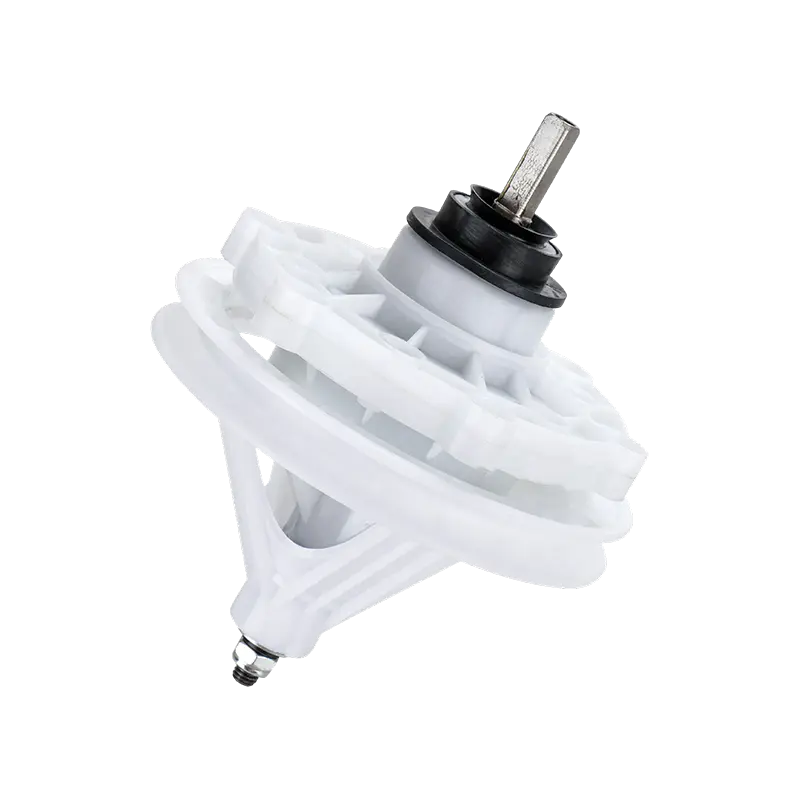
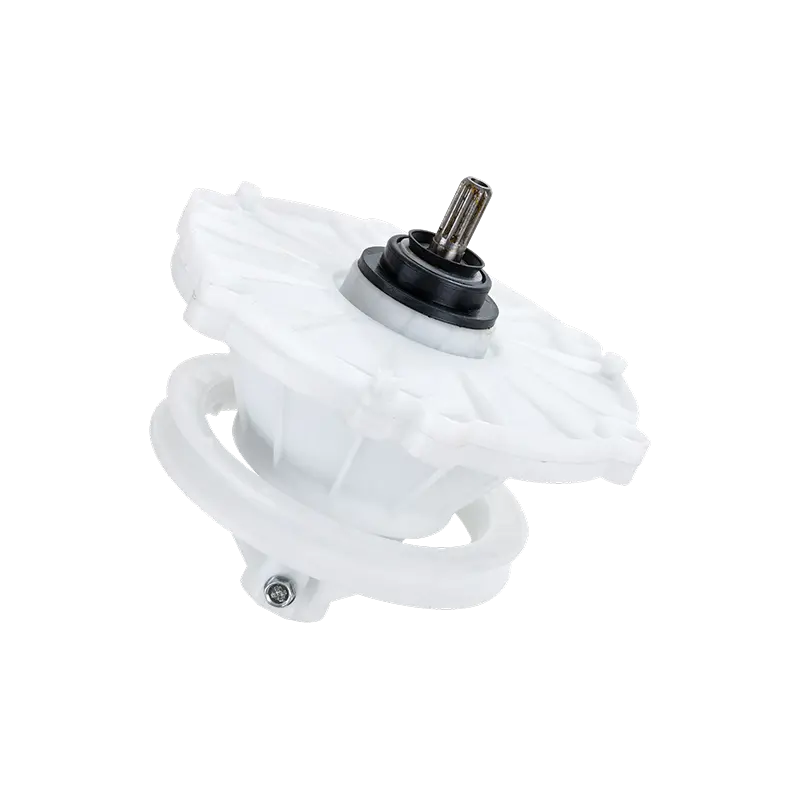
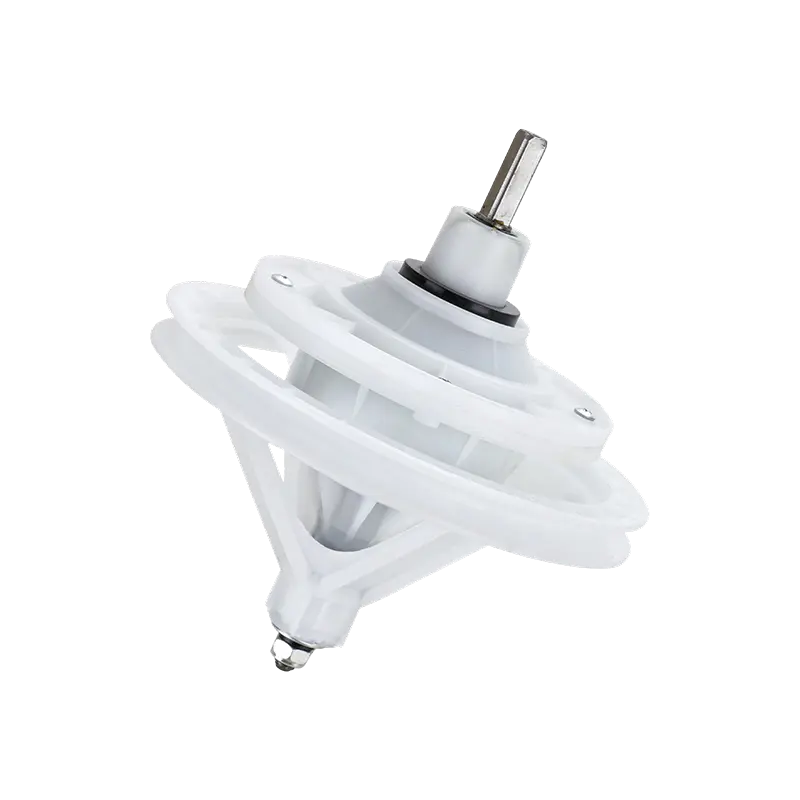
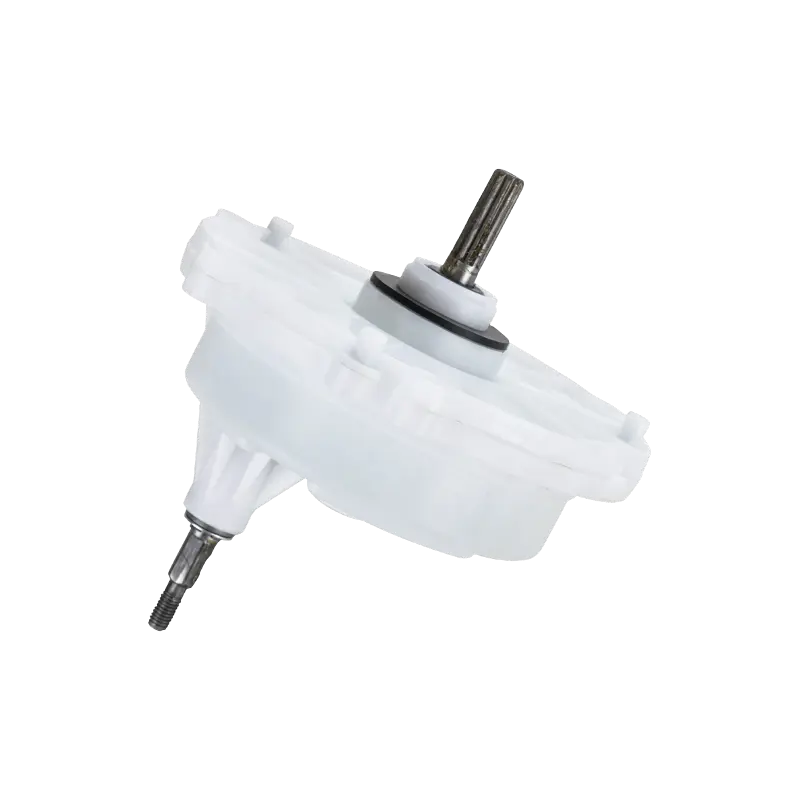
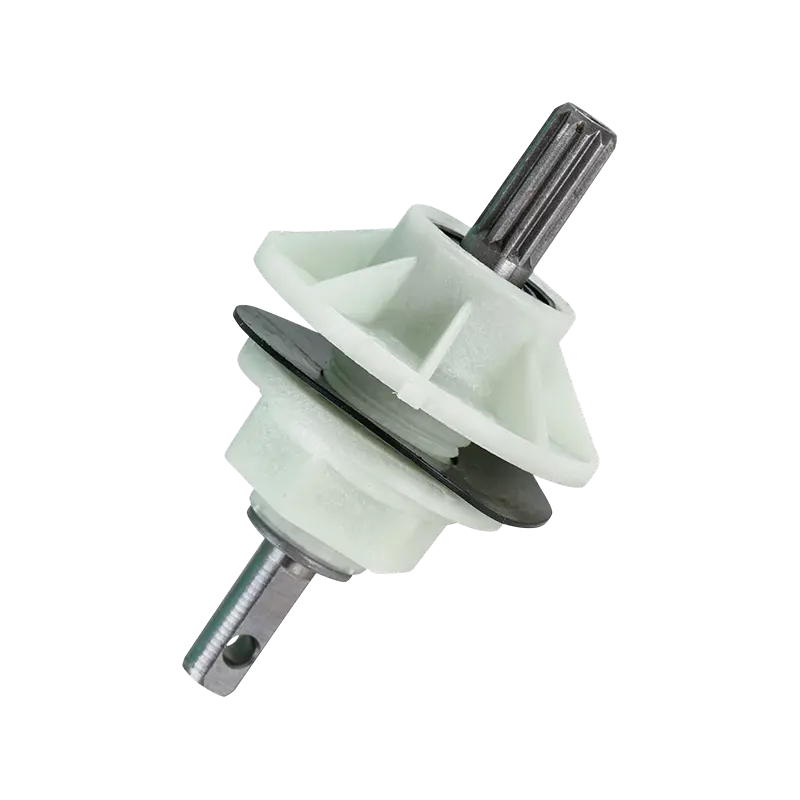
The Washing Machine Transmission is the core power unit of semi-automatic agitator washing machines, used to effectively convert the high-speed rotation of the motor into low-speed, high-torque output suitable for the agitator. This transmission combines durability and cost advantages, can operate stably in humid environments, and provides a reliable and economical power solution for price-sensitive markets.
Product Features Efficient Power Conversion: Uses precision gear design to accurately convert the high-speed power of the motor into low-speed and strong washing power, ensuring uniform agitation of clothes. Lightweight Design: The overall weight is only one-third of traditional metal gear transmission systems, reducing the weight of the washing machine and transportation costs. Durable Materials: Uses high-strength engineering plastics (POM/reinforced nylon) instead of metal gears, maintaining wear resistance while effectively reducing production cost. Maintenance-Free Structure: Gears have a self-lubricating function, requiring no additional grease or seals, eliminating oil leakage risk and reducing daily maintenance burden.
Application Scenarios Core power transmission component of semi-automatic agitator washing machines. Household and light commercial washing machines require low-speed, high-torque output. Washing equipment operating long-term in high-humidity environments. Markets are sensitive to cost and are pursuing durability and stability.
GT005
1
Ø148.5mm
2
Ø120mm (6 holes)
3
Ø34mm
4
73mm
5
26mm
6
40.2mm
7
43.5mm
8
26.5mm
9
192mm
10
ratio:1:5
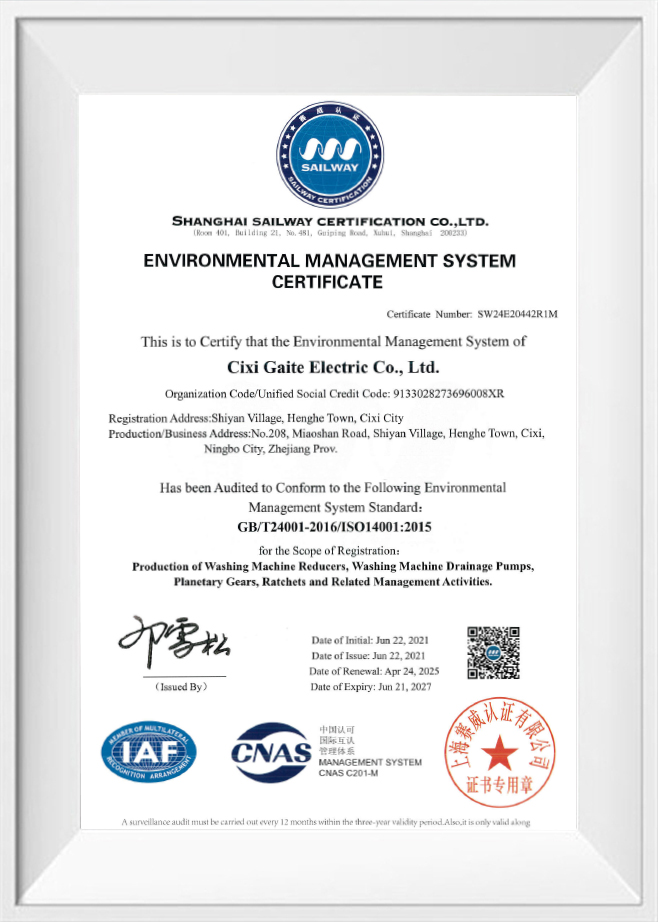
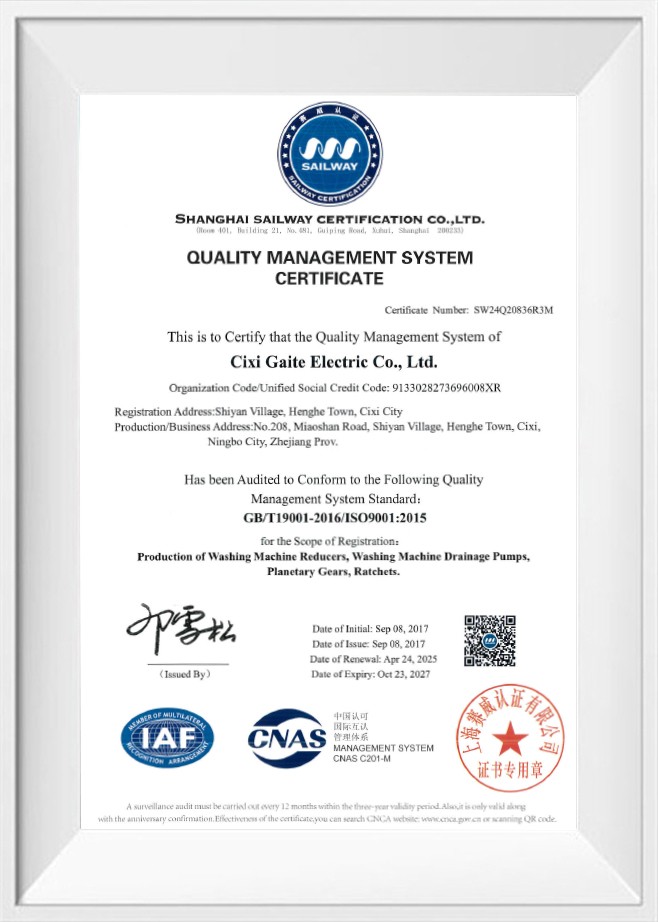
Q: Do you have any international quality certifications for your products?
Yes, our company’s management system and product quality control process have passed ISO9001 international quality management system certification, all production links follow standardized quality inspection rules.
Q: What is the scale of your production plant?
Our production base spans over 10,000 square meters, equipped with standardized production workshops and independent quality inspection zones to support large-volume order production.
Q: Where is your factory located? Is the transportation convenient for bulk order delivery?
Our factory is situated in Ningbo, Zhejiang Province. We enjoy superior geographical advantages with seamless land, sea and air transportation, which ensures efficient and on-time shipment for global orders.
Q: How long has your factory been in the washing machine accessories industry?
We have specialized in manufacturing washing machine accessories since 2002, with nearly two decades of rich industry experience.
Q: What payment terms do you accept?
Trade terms such as FOB and CIF will be confirmed along with the quotation. For mass production, we normally require a 30% advance deposit, with the balance to be paid against a copy of the bill of lading. We mainly accept T/T, and L/C is also negotiable.
Q: Are you a factory or a trading company?
We are a direct manufacturer with independent production capacity, and we have a professional international sales team.
Q: Can you provide samples?
Yes. In-stock samples can be delivered within 3 days, while customized samples will take 7 to 10 days.
Q: How soon can I get your reply after sending an inquiry?
We value every inquiry we receive. We will reply to you within 12 hours upon receipt of your inquiry.
About Us
Cixi Gaite Electric Co., Ltd.
Founded in 2002, GAITE is a China Washing Machine Transmission Supplier and Wholesale Washing Machine Transmission Factory based in Ningbo, Zhejiang. The company specializes in the R&D and manufacturing of core washing machine components, including gear reducers and synchronizers, providing reliable component solutions for OEM manufacturers and aftermarket applications.
With years of development, GAITE now operates a modern production base of approximately 10,000 m², supported by stable production capacity and mature manufacturing processes. Committed to quality, GAITE continuously optimizes product performance and structural design, providing customers with cost-effective component solutions.
1. Overview of Washing Machine Transmission Systems
A washing machine transmission is the mechanical assembly responsible for converting rotational power from the motor into controlled movement of the agitator, pulsator, or spin basket inside a washing machine. In most agitator-type and twin-tub semi-automatic washing machines, the transmission sits between the motor and the wash tub, managing speed reduction, torque distribution, and directional switching between the wash cycle and the spin cycle. Because washing machine motors typically operate at relatively high rotational speeds, a washing machine transmission reduces this speed to a range suitable for effective fabric agitation while increasing torque output at the same time.
The washing machine transmission also plays a role in cycle switching. During the wash phase, the transmission transfers rotational motion to the agitator or pulsator at a lower speed, often with alternating direction, which helps move water and detergent through the fabric load. During the spin phase, many transmission designs redirect power to the spin basket at a higher speed with continuous rotation, supporting water extraction from the load. This dual-function behavior is one of the characteristics that generally distinguishes a washing machine transmission from a simple single-purpose gearbox used in other household appliances.
Because the transmission is positioned at a mechanically demanding point within the washing machine, its structural design, gear material, and clutch mechanism directly influence overall machine performance, including noise level, vibration behavior, and washing consistency across different load types. Washing machine transmission assemblies are typically manufactured as compact, enclosed gear units that integrate multiple gear stages, supporting bearings, and in many cases a clutch or ratchet mechanism, all within a single housing. This overview is intended to provide a foundation for understanding how washing machine transmission systems generally function, the common types available, and the selection considerations discussed in the sections that follow.
2. Working Principle of Washing Machine Transmission
The working principle of a washing machine transmission generally follows a sequence of mechanical steps: speed reduction through gear stages, torque transfer through a clutch or coupling mechanism, and functional switching between wash and spin operation. Understanding this sequence helps explain why washing machine transmission designs vary across different washing machine categories and application requirements.
(1) Gear Reduction Mechanism
The gear reduction mechanism inside a washing machine transmission typically consists of two or more gear stages arranged to progressively reduce rotational speed while increasing torque. Motor input speed in many washing machines can reach well over a thousand revolutions per minute, which is generally too fast for effective fabric agitation. Through successive gear meshing, the washing machine transmission steps this speed down to a range generally suitable for wash-cycle agitation, often well under two hundred revolutions per minute at the output shaft. The specific gear ratio used generally depends on motor characteristics, basket size, and the intended agitation pattern of the washing machine.
(2) Clutch and Direction-Switching Mechanism
Many washing machine transmission designs incorporate a clutch or ratchet mechanism that allows a single motor to drive both the agitation function and the spin function without requiring a separate motor for each task. This mechanism typically engages or disengages specific gear paths depending on motor rotation direction or an internal switching lever, allowing the washing machine transmission to alternate between low-speed agitation and higher-speed spin extraction. The clutch mechanism also generally helps manage torque transfer during load changes, reducing abrupt mechanical stress on the gear train.
(3) Torque Transfer to Agitator and Spin Basket
Once speed has been reduced and the appropriate gear path selected, the washing machine transmission transfers torque to the output shaft, which connects to the agitator, pulsator, or spin basket depending on machine configuration. This output shaft is generally supported by bearings within the transmission housing to help maintain shaft alignment under load. Because the output shaft experiences repeated directional changes and variable load conditions from wet fabric, the structural integrity of this final transfer stage is closely related to gear material selection, a topic discussed further in the following section.
To illustrate how a washing machine transmission progressively reduces rotational speed, the chart below presents a simplified line chart showing typical speed change across gear stages. This chart shows the general reduction pattern from motor input through intermediate gear stages to the final output shaft. The data used in this chart reflects a common gear reduction sequence found in many semi-automatic washing machine transmission designs. Speed values are expressed in revolutions per minute, allowing a general and non-brand-specific comparison of each stage. This visualization is intended to support conceptual understanding of washing machine transmission function rather than to represent an exact specification for any single product.
As shown in the chart, the washing machine transmission begins with a motor input speed that is considerably higher than the final output speed delivered to the agitator shaft. Moving from the motor input point to the first gear stage, rotational speed decreases substantially, reflecting the initial reduction achieved through the first set of meshing gears. The second stage continues this downward trend, further lowering rotational speed while proportionally increasing available torque on the output side. By the time rotational motion reaches the final output stage, speed has been reduced to a level generally appropriate for fabric agitation without generating excessive turbulence or mechanical stress. This stepped reduction pattern is a defining characteristic of washing machine transmission systems, distinguishing them from single-stage gear mechanisms used in simpler appliances. The relationship between speed reduction and torque increase follows standard mechanical principles, where a reduction in rotational speed across a gear train typically corresponds to a proportional increase in torque output. This torque increase is important for washing machine transmission performance because it allows a relatively compact motor to generate sufficient rotational force for moving wet fabric loads. Gear tooth design, material selection, and lubrication all generally influence how smoothly this speed reduction occurs in practice. Variations in this reduction curve across different washing machine transmission models generally reflect differences in target basket size, motor power rating, and intended wash cycle characteristics. Overall, this staged reduction process illustrates why washing machine transmission assemblies are engineered as multi-stage gear systems rather than single-ratio devices.
3. Common Types of Washing Machine Transmission and Their Characteristics
Washing machine transmission assemblies can generally be grouped into a few common categories based on gear material and structural configuration. Each type carries somewhat different characteristics related to durability, noise behavior, and manufacturing complexity, which generally influences how they are selected for different washing machine models.
(1) Plastic Gear Transmission
Plastic gear washing machine transmission assemblies use molded polymer gears, often reinforced with fiber content, for some or all gear stages. This type of transmission is generally associated with lighter weight and comparatively quiet operation, since polymer gear meshing tends to produce less metallic noise than full metal gear trains. Plastic gear transmission designs are commonly used in lighter-duty or residential washing machine categories where load demands are moderate.
(2) Metal Gear Transmission
Metal gear washing machine transmission assemblies use steel or other metal alloy gears throughout the gear train, generally providing higher structural rigidity under sustained load. This configuration is often associated with greater resistance to gear tooth deformation over repeated heavy-load cycles, making it a common choice for washing machine categories that handle larger or heavier fabric loads. Metal gear transmission designs generally involve more complex machining processes compared to molded plastic components.
(3) Gear-Clutch Combination Transmission
A gear-clutch combination washing machine transmission integrates both gear reduction stages and a clutch or ratchet mechanism within a single housing, allowing a single motor to manage both wash and spin functions. This configuration is widely used in semi-automatic twin-tub washing machines, where mechanical switching between agitation and spin extraction is required without a separate spin motor. The combination approach generally balances mechanical complexity with functional versatility.
General characteristics of common washing machine transmission types
Transmission Type
Primary Gear Material
Typical Application
Noise Characteristic
Structural Load Handling
Plastic Gear Transmission
Reinforced polymer
Light-duty residential washers
Generally quieter operation
Moderate
Metal Gear Transmission
Steel / metal alloy
Heavier-duty washing machines
Comparatively higher mechanical noise
Higher
Gear-Clutch Combination Transmission
Mixed gear and clutch components
Semi-automatic twin-tub washers
Varies with clutch engagement
Moderate to high
Noise behavior is one of the more commonly discussed characteristics when comparing washing machine transmission types. The horizontal bar chart below presents a general illustrative comparison of typical operating noise levels associated with each transmission type discussed above. These values represent general reference ranges based on common engineering characteristics of gear material and mechanism design, rather than measurements from any specific product. Noise level in a washing machine transmission is influenced by multiple factors, including gear material, gear tooth precision, lubrication, and housing structure. This chart is intended to support general understanding of relative noise tendencies across transmission types rather than to serve as a precise technical specification.
As shown in the chart, plastic gear washing machine transmission assemblies are generally associated with comparatively lower operating noise levels among the three types illustrated. This tendency is largely attributed to the inherent damping characteristics of polymer materials, which absorb some vibration during gear meshing compared to rigid metal-to-metal contact. Metal gear washing machine transmission assemblies, by contrast, generally show higher noise levels in this illustrative comparison, reflecting the more rigid mechanical interaction between metal gear teeth during operation. Gear-clutch combination transmission types fall within a middle range in this chart, since their noise characteristics generally depend on both the gear material used and the mechanical behavior of the clutch or ratchet component during engagement and disengagement. It is worth noting that noise level alone does not determine overall transmission suitability, since structural load handling and durability considerations often favor metal gear configurations in heavier-duty applications despite higher noise levels. Lubrication quality and gear tooth surface finish can also meaningfully affect actual noise output within any of these transmission categories, sometimes narrowing the gap shown in this general illustration. Housing design, including damping materials or structural reinforcement around the gear train, further influences how much operating noise is transmitted to the washing machine cabinet and, ultimately, to the surrounding environment. Because washing machine transmission noise interacts with multiple variables beyond gear material alone, manufacturers generally evaluate noise performance alongside torque output and durability testing rather than in isolation. This chart should therefore be read as a general directional reference for comparing transmission types rather than an exact prediction of noise output for any specific washing machine model. Overall, noise-related characteristics remain one of several factors relevant to washing machine transmission selection, alongside load capacity and duty cycle requirements discussed in the next section.
4. Application Scenarios and Selection Points
Selecting an appropriate washing machine transmission for a given application generally involves evaluating several interrelated factors, including load capacity requirements, duty cycle frequency, and mechanical compatibility with the motor and basket assembly used in a particular washing machine model.
(1) Load Capacity Considerations
Washing machine transmission assemblies are generally matched to a target load capacity range, since gear tooth strength and shaft diameter influence how much mechanical stress the transmission can handle during agitation and spin cycles. Washing machines designed for smaller load capacities typically use transmission assemblies optimized for moderate torque output, while washing machines intended for larger or heavier loads generally require transmission components with reinforced gear structures.
(2) Duty Cycle and Usage Frequency
Duty cycle refers to how frequently and for how long a washing machine transmission operates within a given period. Washing machine transmission assemblies used in higher-frequency application settings generally benefit from more robust gear material and bearing support to accommodate repeated engagement cycles over an extended service period. Selection decisions in this area often weigh expected usage frequency against the gear material characteristics discussed in the previous section.
(3) Compatibility with Motor and Basket Design
A washing machine transmission generally needs to be compatible with the mounting configuration, shaft dimensions, and rotational characteristics of the motor and basket assembly it is paired with. Mismatched transmission and motor specifications can lead to inefficient torque transfer or increased mechanical wear over time, which is why transmission selection is typically approached as part of an integrated washing machine drive system design rather than as an isolated component decision.
Load capacity requirements vary meaningfully across different washing machine application categories, which directly relates to washing machine transmission selection. The vertical bar chart below illustrates general reference ranges for typical maximum load capacity across three common washing machine application categories. These values are presented as general illustrative ranges rather than fixed specifications, since actual load capacity depends on the specific transmission and motor combination used. This chart is intended to support conceptual understanding of how application category relates to load capacity expectations. Reviewing this relationship can help clarify why washing machine transmission designs differ across residential, standard semi-automatic, and heavier-duty application settings.
As illustrated in the chart, light residential washing machine applications are generally associated with comparatively lower maximum load capacity requirements, which typically allows for a washing machine transmission design with moderate gear reinforcement. Standard semi-automatic washing machine applications, shown in the middle bar, generally require a transmission capable of handling a moderately higher load range, reflecting more frequent use across varied fabric types and load sizes. Heavy-duty twin-tub washing machine applications, represented by the tallest bar in this chart, generally involve the highest load capacity requirements among the three categories, which typically calls for a washing machine transmission with more robust gear material and reinforced shaft support. This progression illustrates a general relationship between application category and structural demand placed on the transmission assembly. It is worth noting that load capacity is only one of several selection factors, since duty cycle frequency and motor torque characteristics also influence which washing machine transmission configuration is appropriate for a given application. Washing machine transmission assemblies intended for higher load categories often incorporate additional bearing support or reinforced housing structure to help distribute mechanical stress more evenly during operation. Selection decisions informed by this type of load capacity comparison generally aim to align transmission structural capability with expected usage conditions rather than maximizing capacity beyond what a given application requires. Over-specifying a washing machine transmission for a lighter-duty application can add unnecessary weight, while under-specifying for a heavier-duty application may increase long-term wear. This chart therefore serves as a general starting reference point for aligning washing machine transmission characteristics with intended application category. Selection is generally finalized in coordination with motor specifications and basket design, as outlined in the compatibility considerations above.
5. Performance Comparison Across Transmission Types
Beyond noise and load capacity, washing machine transmission types can also be compared across several performance-related attributes at the same time, including durability, transmission efficiency, and maintenance simplicity. A multi-attribute comparison of this kind can help illustrate general trade-offs associated with each transmission type discussed in the previous sections.
The radar chart below presents a general illustrative comparison of three washing machine transmission types across five commonly referenced performance attributes: durability, noise control, transmission efficiency, maintenance simplicity, and structural stability. Each axis in this chart represents a relative score on a general scale, allowing multiple characteristics to be viewed together rather than in isolation. The scores shown reflect general engineering tendencies associated with each transmission type based on the gear material and mechanism design discussed earlier in this guide. This chart is not intended to represent exact performance data for any specific washing machine transmission product, but rather to support conceptual comparison across categories. Viewing these attributes together can help illustrate why washing machine transmission type selection often involves balancing multiple factors rather than optimizing for a single characteristic.
As shown in the radar chart, metal gear washing machine transmission assemblies generally score comparatively higher on durability and structural stability, reflecting the rigidity and wear resistance associated with metal gear material under sustained load. Plastic gear washing machine transmission assemblies, by comparison, generally show relatively higher scores in noise control and maintenance simplicity, consistent with the damping characteristics and simpler servicing generally associated with molded polymer components. Gear-clutch combination transmission types generally occupy a more balanced position across most attributes in this chart, reflecting their role in applications that require both gear reduction and mechanical switching functionality within semi-automatic washing machines. Transmission efficiency scores shown in the chart tend to favor metal gear configurations, generally attributed to lower deformation under load and more consistent gear meshing over repeated cycles. At the same time, the chart illustrates that no single washing machine transmission type scores highest across every attribute simultaneously, which reflects the general engineering trade-off between structural rigidity, noise behavior, and servicing convenience. This kind of multi-attribute visualization can be useful during washing machine transmission selection because it highlights how a design choice favoring one characteristic, such as durability, may correspond to a comparatively lower score in another characteristic, such as noise control. Maintenance simplicity scores in the chart generally relate to how accessible internal components are for inspection or lubrication, which can vary depending on housing design in addition to gear material. Structural stability scores reflect how well a transmission type generally maintains shaft alignment and gear engagement under repeated load cycling over time. When reviewing this chart, it is useful to consider it alongside the load capacity and duty cycle discussion in the previous section, since application requirements often determine which combination of attributes is most relevant for a given washing machine transmission selection. Overall, this radar comparison is intended to support a more holistic view of washing machine transmission characteristics rather than to rank any single type as universally preferable to another.
6. Typical Application Cases
Washing machine transmission assemblies are used across several common washing machine configurations, each with somewhat different functional requirements.
(1) Semi-Automatic Twin-Tub Washers
In semi-automatic twin-tub washing machines, the washing machine transmission is typically responsible for driving the pulsator in the wash tub while a related mechanism, often within the same transmission housing, manages spin basket rotation in the adjoining tub. This configuration generally relies on a gear-clutch combination transmission to switch between these two functions using a single motor.
(2) Fully Automatic Top-Load Washers
In fully automatic top-load washing machines, the washing machine transmission or an equivalent drive mechanism typically manages both agitation and spin functions within a single tub, often coordinated through a control system that manages motor direction and timing. Depending on design, some fully automatic models use a direct-drive motor configuration alongside a simplified transmission, while others retain a more traditional gear-based transmission assembly.
(3) Commercial-Style Heavy-Duty Washers
Commercial-style or heavier-duty washing machine categories generally place higher structural demands on the washing machine transmission due to larger load capacities and more frequent operating cycles. These applications typically favor metal gear transmission configurations, reflecting the durability and load-handling characteristics discussed in earlier sections of this guide.
7. Maintenance Guidance for Washing Machine Transmission
Routine attention to washing machine transmission condition can generally help maintain consistent operation over the service life of a washing machine. The following general maintenance points are commonly referenced across washing machine transmission servicing practices.
Periodic lubrication check: gear surfaces within a washing machine transmission generally benefit from periodic lubrication inspection, since inadequate lubrication can increase friction and gear wear over time.
Listening for unusual noise: a noticeable change in operating noise, such as grinding or knocking sounds, can generally indicate gear wear or misalignment within the transmission assembly and may warrant further inspection.
Checking for excessive vibration: increased vibration during agitation or spin cycles can sometimes point to bearing wear or shaft misalignment inside the washing machine transmission housing.
Inspecting for grease leakage: visible grease residue around the transmission housing may indicate seal wear, which can generally reduce internal lubrication effectiveness if left unaddressed.
Monitoring clutch engagement behavior: in gear-clutch combination transmission types, irregular switching between wash and spin function can generally suggest clutch component wear that may require attention.
Avoiding consistent overloading: repeatedly operating a washing machine beyond its rated load capacity can generally accelerate wear on transmission gear teeth and shaft components over time.
8. Manufacturing and Component Sourcing Considerations
Washing machine transmission components are generally produced by manufacturers with established gear-cutting, precision-molding, and assembly capabilities, since consistent dimensional tolerances are important for proper integration with motor and basket assemblies. Component-level specialization is common across the washing machine transmission supply chain, where gear reducers, clutch mechanisms, and related synchronizer parts are engineered to work within a range of original equipment manufacturer product platforms.
Cixi Gaite Electric Co., Ltd., established in 2002 and based in Ningbo, Zhejiang, is one manufacturer within this component category, focusing on washing machine components such as gear reducers and synchronizers used within transmission assemblies. The company operates a production base of approximately 10,000 square meters and supports both original equipment manufacturer and aftermarket component supply. Manufacturers working in this area generally emphasize structural optimization and consistent production processes to help washing machine transmission components maintain compatibility across different motor and basket configurations used by washing machine producers.
When evaluating washing machine transmission component sourcing, manufacturers and buyers generally consider factors such as gear material consistency, dimensional accuracy, and production capacity stability, since these factors influence how reliably transmission components can be integrated into ongoing washing machine production processes.
9. Frequently Asked Questions
What is the main function of a washing machine transmission?
A washing machine transmission generally reduces motor rotational speed while increasing torque, and in many designs also manages switching between wash-cycle agitation and spin-cycle extraction.
What are the common types of washing machine transmission?
Common washing machine transmission types generally include plastic gear transmission, metal gear transmission, and gear-clutch combination transmission, each associated with different characteristics related to noise, durability, and structural load handling.
How can early signs of washing machine transmission wear be identified?
Early signs generally include unusual operating noise, increased vibration, irregular switching between wash and spin function, and visible grease residue around the transmission housing.
Does washing machine transmission type affect operating noise?
Gear material and mechanism design generally influence operating noise, with plastic gear transmission types typically associated with comparatively quieter operation and metal gear transmission types typically associated with higher noise levels under load.
What factors are generally considered when selecting a washing machine transmission for a specific application?
Selection generally involves evaluating load capacity requirements, duty cycle frequency, and compatibility with the motor and basket assembly used in a particular washing machine model.
Why do some washing machine transmission assemblies include a clutch mechanism?
A clutch or ratchet mechanism generally allows a single motor to manage both agitation and spin functions by switching gear engagement paths within the transmission housing, which is common in semi-automatic twin-tub washing machine designs.


 English
 عربى


 +86-574-63256717 /63267914
info@gaite.cn
 gaite@gaite.cn
 No. 208 Miaoshan Road, Shiyan Village, Henghe Town, Cixi City, Ningbo City, Zhejiang Province, China
