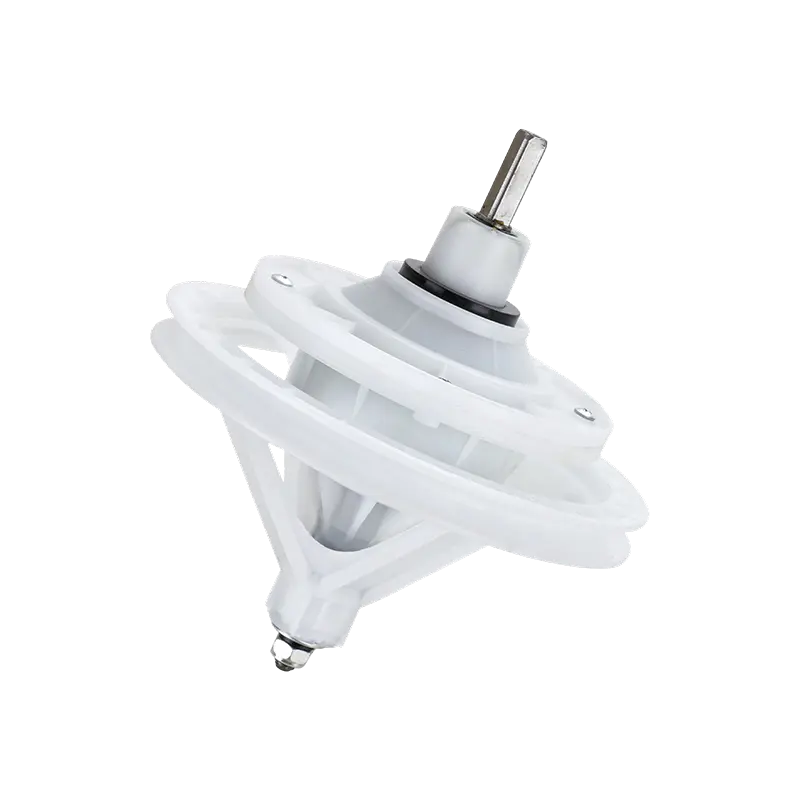
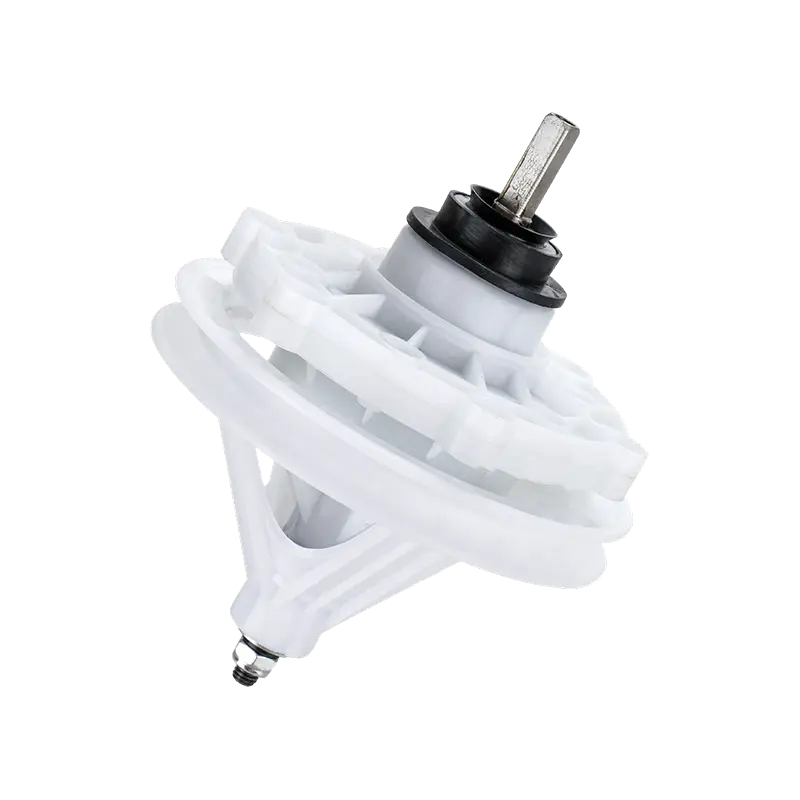
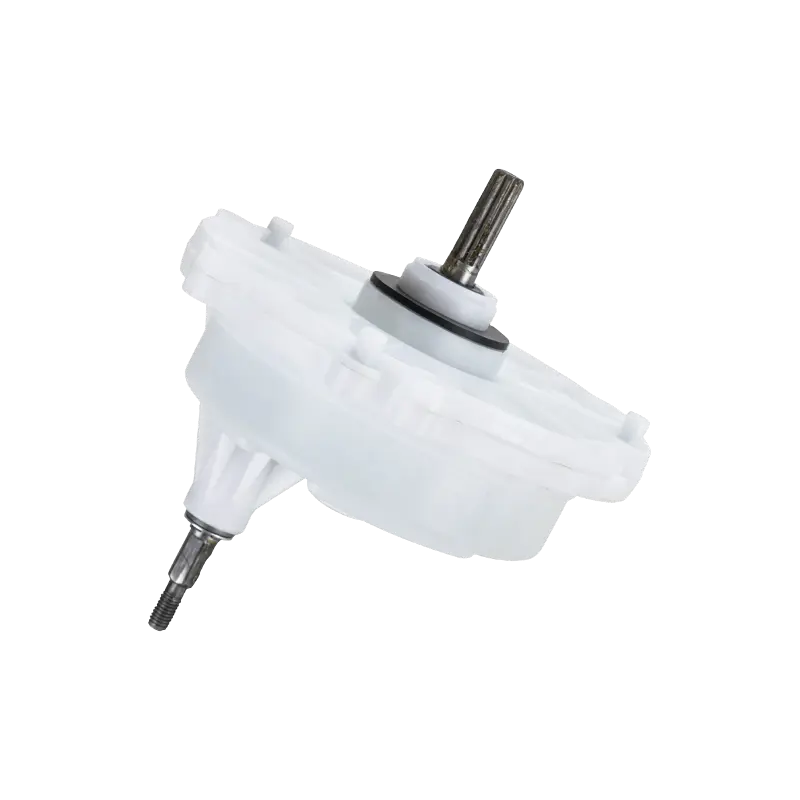
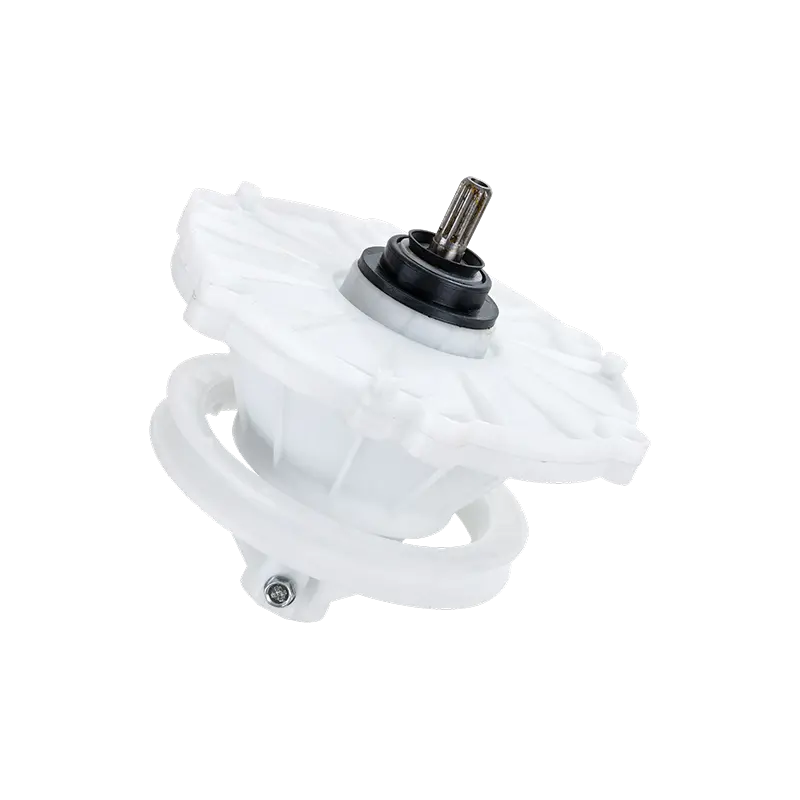
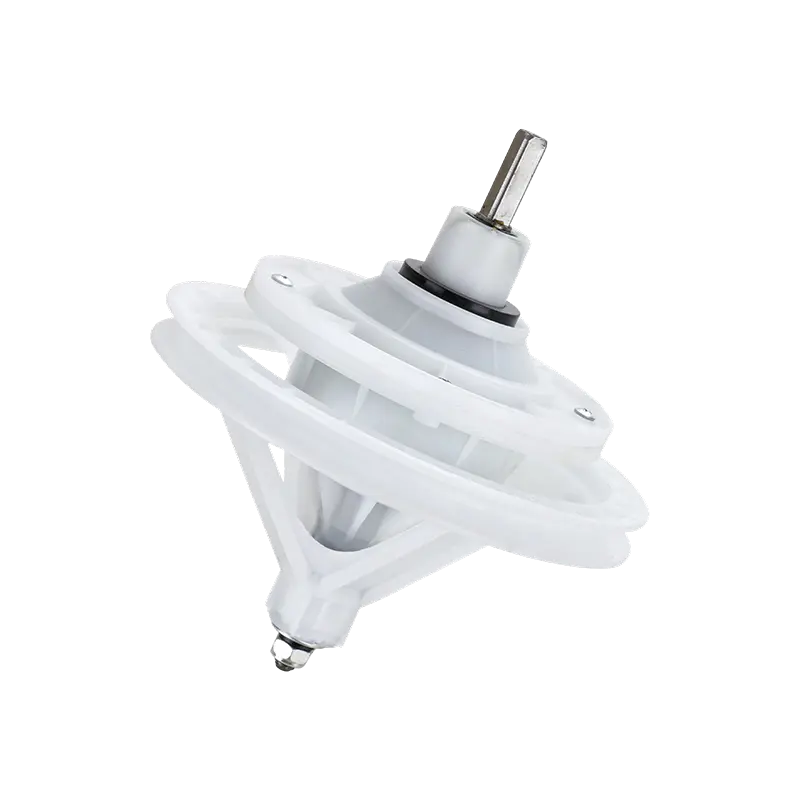
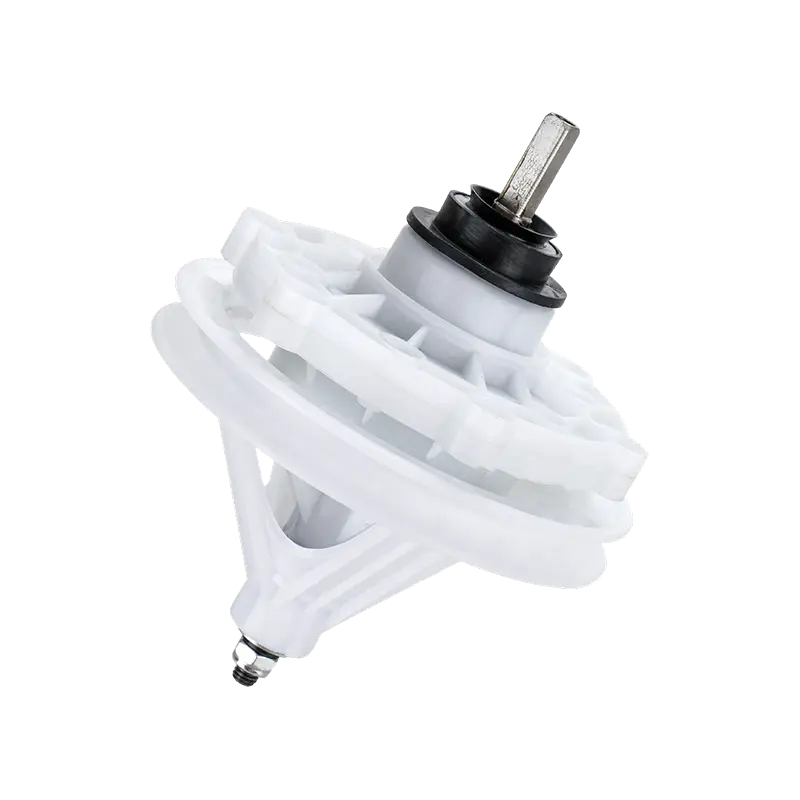
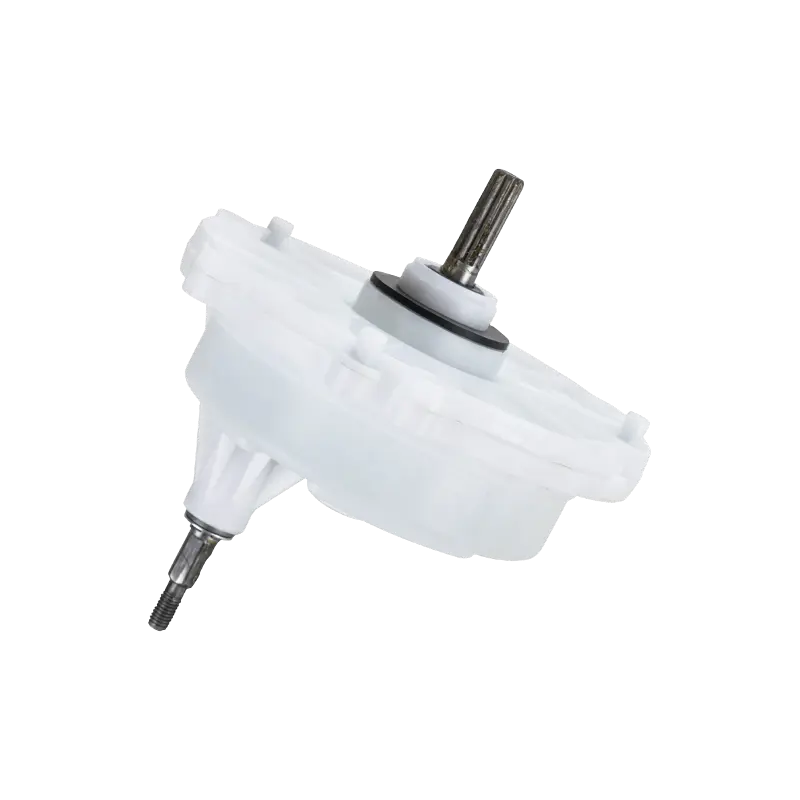
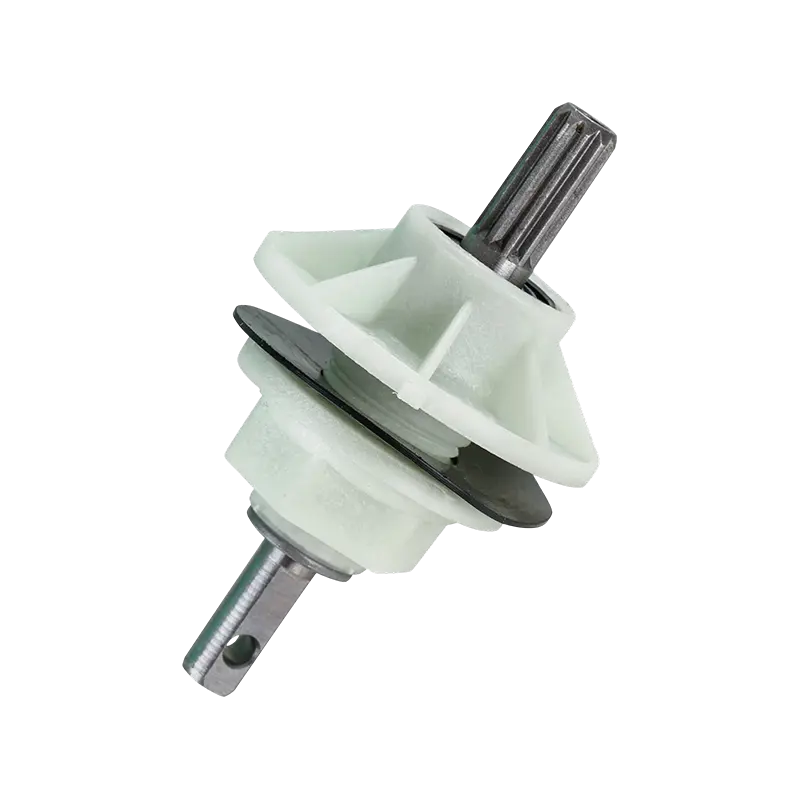
The Washing Machine Gearbox is a key mechanical component in the power transmission system of a washing machine. Its main function is to reduce the speed and increase the torque of the motor output, converting high-speed rotation into low-speed, high-torque motion suitable for washing conditions, thereby driving the agitator plate to more effectively circulate water flow and clothes for tumbling. The Washing Machine Gearbox is usually designed around a stable gear transmission relationship in its structural design to ensure continuous and smooth power output and to reduce the impact of load fluctuations on the motor.
From a functional perspective, the core value of the Washing Machine Gearbox lies in achieving power conversion and torque enhancement, enabling the washing process to maintain sufficient stirring force at lower speeds, thereby improving washing efficiency and reducing energy consumption fluctuations. At the same time, this component also helps improve the operational stability of the whole machine and reduces mechanical shock caused by load changes.
From an application perspective, the Washing Machine Gearbox is widely used in semi-automatic and some agitator-type washing machines. It is an important transmission unit connecting the motor and the washing actuator system, and is suitable for household and light commercial washing equipment. In different structural designs, this type of gearbox can be configured according to transmission requirements to meet the product needs of washing machines with different capacities and usage intensities.
About Us
Cixi Gaite Electric Co., Ltd.
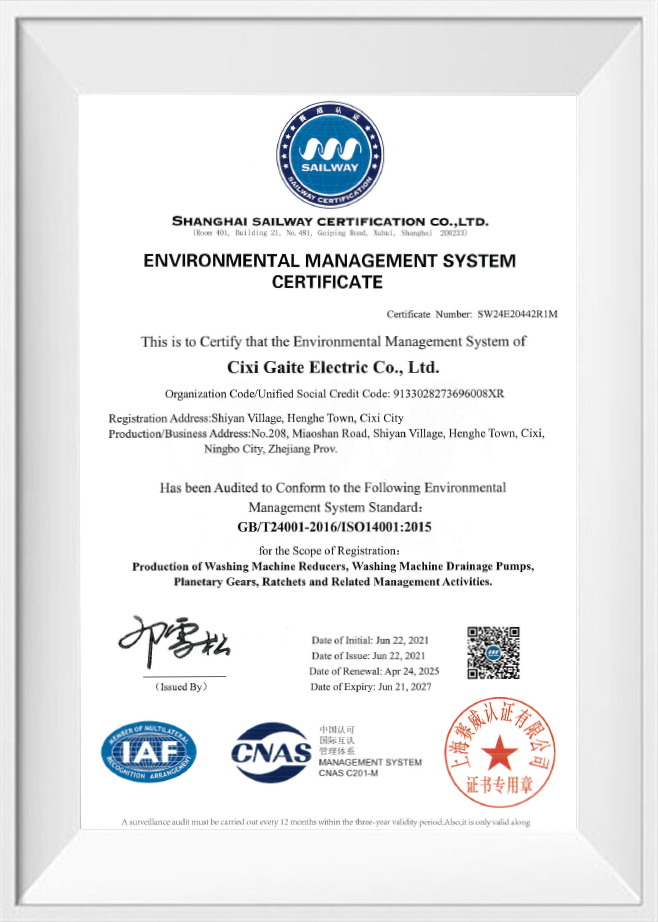
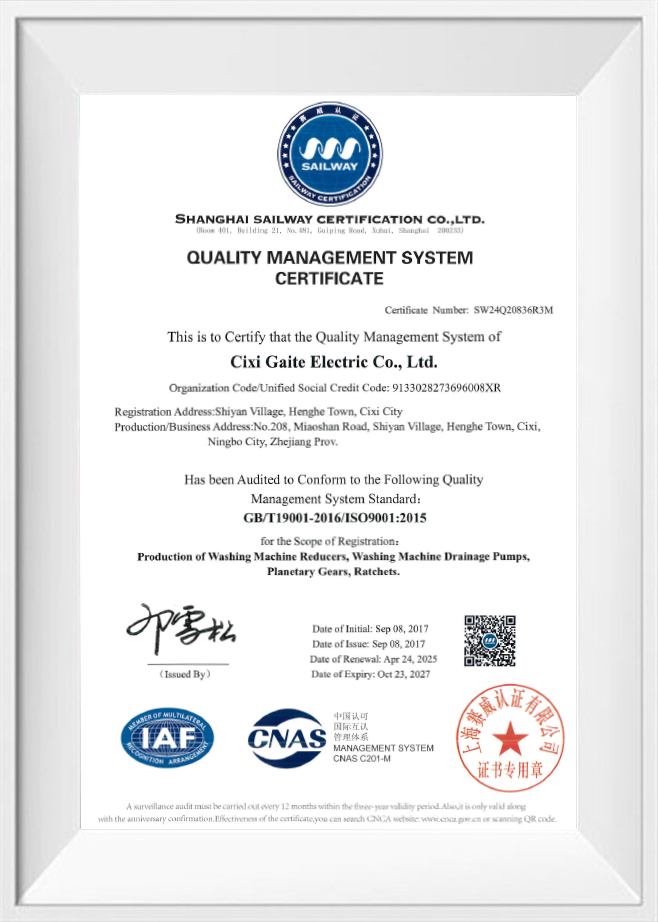
Founded in 2002, GAITE is a China Washing Machine Gearbox Manufacturer and Custom Washing Machine Gearbox Supplier based in Ningbo, Zhejiang. The company specializes in the R&D and manufacturing of core washing machine components, including gear reducers and synchronizers, providing reliable component solutions for OEM manufacturers and aftermarket applications.
With years of development, GAITE now operates a modern production base of approximately 10,000 m², supported by stable production capacity and mature manufacturing processes. Committed to quality, GAITE continuously optimizes product performance and structural design, providing customers with cost-effective component solutions.
A purchasing team can approve a washing machine gearbox sample in April, only to face noise complaints in August because the shaft fit, lubricant, or mounting tolerance was never ...
Actuators in washing machines are small electromechanical parts, but they sit at the center of a much larger drivetrain decision. In a typical top-load washer, the shift actuator ...
A washing machine transmission failure rarely happens at a convenient time. For repair shops, the problem shows up as a customer complaint about a noisy spin cycle or a drum that ...
A washing machine parts diagram is the fastest way to explain how a washer works and the slowest way to order the right component. A technician opens the service manual, finds the...
A washing machine P-shaft manufacturer supplies the pulsator shaft that connects a washer's gearbox output directly to the pulsator or agitator disc, transmitting rotational torque...
1. Understanding the Washing Machine Gearbox Category
A washing machine gearbox is the mechanical unit responsible for converting motor rotation into the two distinct motions a washing machine needs during operation, namely the slower oscillating movement used for washing and the faster continuous rotation used for spinning. Within this broader category, the term generally covers gear reducers, clutch assemblies, and the synchronizer units that coordinate timing between mechanical motion and cycle transitions. A washing machine gearbox typically works alongside a drive motor, a drum shaft, and in many designs a synchronizer that helps regulate when the machine shifts between wash agitation and spin extraction. Because this assembly carries repeated mechanical load across thousands of operating cycles, the internal gear structure, shaft alignment, and clutch engagement mechanism are engineered to distribute torque evenly while limiting excess vibration and noise. This category page brings together the common structural types, working principles, and selection considerations that apply across washing machine gearbox products used in both original equipment integration and replacement part applications.
2. Common Types of Washing Machine Gearbox and Their Structural Characteristics
Washing machine gearbox products are generally grouped into a few recognizable structural categories, each suited to a different drive arrangement and appliance layout. Reviewing these categories side by side makes it easier to understand which structure fits a particular drum size, motor type, or spin speed requirement.
(1) Belt-Driven Washing Machine Gearbox
In this arrangement, the motor connects to the gearbox input shaft through a belt and pulley system rather than a direct coupling. The belt allows a certain amount of speed reduction before the gearbox itself performs the remaining torque conversion, which is a layout commonly found in established top-load washing machine platforms. The separation between motor and gearbox also allows some flexibility in motor placement within the appliance chassis.
(2) Direct-Drive Washing Machine Gearbox
A direct-drive gearbox connects the motor shaft directly to the gearbox input without an intermediate belt, reducing one source of mechanical loss and typically lowering operating noise. This structure is more common in newer appliance designs where compact layout and quieter operation are priorities during the wash and spin cycle.
(3) Planetary Gear Reducer Type
Planetary gear reducers distribute mechanical load across multiple planet gears arranged around a central sun gear, spreading contact stress over several gear pairs instead of concentrating it on a single pair. This structure supports higher torque transmission and is generally associated with heavier duty cycles, larger drum capacities, or commercial-grade washing equipment.
(4) Synchronizer Unit Paired with Gearbox
A synchronizer works alongside the gearbox to help coordinate timing between mechanical motion and other cycle events, such as water intake, drum direction reversal, or the transition into spin mode. Rather than functioning as a standalone drive component, the synchronizer supports the gearbox by keeping mechanical and electrical cycle stages aligned as the appliance progresses through a wash program.
3. Working Principle Behind Gearbox and Synchronizer Coordination
During the wash phase, the gearbox typically reduces motor speed and reverses rotation direction at set intervals, producing the back-and-forth agitation motion that moves fabric and detergent through the water. A clutch mechanism inside the gearbox housing engages this lower-speed pathway during washing and then disengages it once the cycle moves into spin mode, at which point the gearbox switches to a higher-speed, single-direction output that drives water extraction from the drum. The synchronizer, where present, monitors this transition point and helps time it against other appliance functions, such as drain valve activation or water level sensing, so that the mechanical and hydraulic stages of the cycle proceed in the correct sequence. This coordination between gear reduction, clutch engagement, and synchronizer timing is what allows a washing machine gearbox to move smoothly between two very different mechanical demands within a single operating cycle.
4. Application Scenarios and Selection Considerations
Selecting the right washing machine gearbox structure depends heavily on the appliance segment it will serve, since drum capacity, spin speed targets, and expected duty cycle all vary across product tiers. A standard household top-load washer generally places different demands on a gearbox than a commercial-grade unit that runs longer cycles at higher frequency throughout the day. Reviewing how gearbox types are distributed across appliance segments gives a practical starting point for narrowing down which structure fits a given selection requirement. The chart below presents a representative distribution of gearbox application share across four common washing machine segments. This distribution reflects how structural choice tends to follow drum size, spin speed range, and expected daily cycle count rather than a single universal design applying equally well across every segment.
Standard top-load washers make up the largest share at 38 percent, which lines up with how widely this appliance format is used in household settings and why belt-driven or direct-drive gearbox structures are frequently specified for this segment. Heavy-duty top-load washers follow at 27 percent, a segment that often calls for a stronger gear reduction ratio or a reinforced clutch to handle larger drum loads without shortening service life. Front-load compact washers account for 22 percent, and this segment tends to favor direct-drive structures because of their generally lower operating noise and more compact housing footprint compared to belt-driven alternatives. Commercial-grade washers represent the smallest share at 13 percent, yet this segment is where planetary gear reducers are most commonly selected, since the higher cycle frequency and heavier load conditions in commercial settings place greater demand on torque distribution across the gear set. The relatively even spread across these four segments illustrates why a washing machine gearbox category cannot rely on a single structure to serve every application well. Selection therefore starts with identifying the drum capacity and expected daily cycle count of the target appliance, then narrowing the structural type based on the noise and torque priorities of that segment. A household appliance manufacturer focused on standard top-load platforms will generally prioritize different structural traits than a commercial laundry equipment producer building for continuous daily operation. Mounting geometry, shaft dimensions, and output speed also need to align with the specific motor and drum design already in use on a given platform. For this reason, gearbox selection is typically approached as a matching exercise between appliance segment requirements and available structural types rather than a search for one design intended to cover every scenario. Buyers evaluating a washing machine gearbox for a new or existing platform benefit from reviewing this kind of segment distribution alongside their own drum size and cycle frequency data before finalizing a structural choice. This approach reduces the likelihood of selecting a gearbox structure that is either under-built for the intended duty cycle or unnecessarily complex for a lighter household application.
5. Structural Comparison Across Gearbox Types
The table below summarizes the structural principle, typical torque range, and noise characteristic associated with each common washing machine gearbox type, providing a condensed reference point for comparing options side by side.
Structural comparison of common washing machine gearbox types across typical appliance platforms.
Gearbox Type
Structural Principle
Typical Torque Range
Noise Characteristic
Common Segment
Belt-Driven
Motor connects to gearbox input via belt and pulley
Medium
Moderate
Standard Top-Load
Direct-Drive
Motor shaft connects directly to gearbox input
Medium to High
Lower
Front-Load Compact
Planetary Reducer
Multiple planet gears around a central sun gear
High
Low to Moderate
Commercial-Grade
Reviewing torque range and noise characteristic together is useful because these two factors often move in opposite directions depending on structure. A planetary reducer generally supports higher torque while keeping noise relatively contained, which explains its association with heavier commercial applications where both durability and workplace noise levels matter.
6. Durability Performance Across Duty Cycles
Torque retention across repeated duty cycles is one of the more informative ways to evaluate how a washing machine gearbox holds up over its expected service life. This measurement tracks how much of the original torque output capacity remains after a defined number of simulated wash-and-spin cycles under controlled test conditions. Reviewing this kind of curve helps distinguish between a gearbox that wears gradually and predictably and one that may hide a weak point likely to surface only after extended use. The chart below shows a representative torque retention pattern recorded across 100,000 simulated duty cycles. This type of data is generally more informative than a single durability claim, since the shape of the decline over time reveals how consistently a gear structure performs as wear accumulates.
The line traces a gradual, steady decline rather than a sudden drop, which is the pattern generally associated with a gear structure wearing evenly across its contact surfaces. At 20,000 simulated cycles, the tested unit retains 98 percent of its original torque output, showing minimal early-stage wear under normal load conditions. By 40,000 cycles, retention sits at 96 percent, and this slow early decline typically reflects a well-matched heat treatment process across the gear teeth. The curve continues to soften gradually through 60,000 and 80,000 cycles, reaching 94 percent and 91 percent respectively, a range where minor surface wear becomes measurable without affecting overall function. At the full 100,000-cycle mark, the gearbox retains 89 percent of its rated torque, which provides a useful reference point for estimating how a component might behave across several years of typical household or commercial use. The slightly steeper decline observed between 60,000 and 100,000 cycles is a normal characteristic of gear wear accumulation and is generally expected rather than unusual. A curve of this shape suggests the gear tooth profile and heat treatment process were reasonably well controlled during production, since inconsistent treatment tends to produce a sharper, less predictable drop at some point along the curve. Reviewing torque retention data across the full duty cycle range, rather than only an early segment, gives a clearer picture of how a gearbox is likely to perform as it approaches the higher end of its expected service life. This type of longer-range testing is more representative of real household or commercial use than a shorter test limited to only a few thousand cycles. For buyers comparing multiple gearbox options, requesting data that extends through at least 80,000 to 100,000 cycles offers a more complete basis for evaluating long-term mechanical reliability.
7. Production Scale and Manufacturing Consistency
Manufacturing consistency across large production volumes is what allows a washing machine gearbox to perform the same way in unit one thousand as it did in unit one, and this consistency depends heavily on the scale and organization of the production facility behind it. Reviewing how annual output is distributed across gearbox structure types offers a useful indicator of how established a given manufacturing operation actually is. This section looks at that distribution alongside a brief note on the kind of production infrastructure that typically supports it. The chart below presents a representative breakdown of annual manufacturing output by gearbox structure type, expressed as a percentage share of total volume. This distribution reflects how belt-driven and direct-drive structures generally dominate overall production volume given their widespread use across standard household appliance platforms.
Belt-driven structures lead the distribution at 34 percent of annual output, which aligns with their continued use across a wide base of established top-load washing machine platforms. Direct-drive structures follow closely at 29 percent, reflecting steady adoption across newer appliance designs that prioritize quieter operation. Planetary reducers account for 24 percent of output, a share that corresponds to their use in heavier duty and commercial-grade equipment rather than high-volume household platforms. Custom synchronizer-integrated units make up the smallest share at 13 percent, since these configurations are typically developed for specific platform requirements rather than produced as a general-purpose catalog item. Sustaining this kind of output across four distinct structural categories requires a production base with enough tooling variety and floor space to run multiple assembly lines without one category disrupting capacity for another. Cixi Gaite Electric Co., Ltd., founded in 2002 and based in Ningbo, Zhejiang, operates a production base of approximately 10,000 square meters supporting this kind of multi-category manufacturing, with a focus specifically on gear reducers and synchronizers for both OEM integration and aftermarket supply. Maintaining stable output across belt-driven, direct-drive, and planetary reducer categories within a single facility depends on mature process control at each stage, from gear cutting through heat treatment and final assembly. This kind of production breadth also supports more consistent lead times for buyers who require more than one gearbox structure across different appliance platforms within their own product range. A facility organized around gear reducer and synchronizer manufacturing specifically, rather than a broader mix of unrelated appliance parts, tends to apply more focused process control to the dimensional and heat treatment steps that most directly affect gearbox durability. Reviewing a facility's production scale alongside its structural output distribution gives a more grounded basis for evaluating manufacturing consistency than a general description of capability alone.
Beyond torque range and production volume, several other characteristics influence how a given gearbox structure fits a particular appliance requirement, including durability, noise control, torque capacity, customization flexibility, and maintenance ease. Comparing two structural types across these five dimensions at once provides a more complete picture than looking at any single factor in isolation. The radar chart below compares belt-driven and planetary reducer structures across these five dimensions, each scored on a scale from one to ten. This comparison is intended to highlight relative structural tendencies rather than suggest one type is universally preferable to the other. The dimensions selected reflect the factors most commonly referenced when matching a gearbox structure to a specific appliance platform.
The chart shows planetary reducer structures scoring higher on both durability and torque capacity, which reflects how load distribution across multiple planet gears supports heavier and more frequent cycling compared to a single gear pair arrangement. Belt-driven structures score slightly higher on maintenance ease, largely because belt and pulley components are generally more straightforward to inspect and service compared to the fully enclosed gear train of a planetary design. Noise control shows a moderate difference between the two, with planetary reducers holding a small advantage, though both structures remain within an acceptable range for their respective typical applications. Customization flexibility is fairly close between the two types, since both can be adapted to different shaft dimensions and mounting configurations depending on the appliance platform being served. The gap between the two profiles is widest on torque capacity and durability, which is the primary reason planetary reducers are more often specified for commercial-grade or heavy-duty equipment rather than standard household platforms. This does not mean a belt-driven structure is a lesser choice, since for many standard household applications the torque and durability levels it provides are entirely sufficient for the expected duty cycle. The comparison instead helps clarify that structural choice should follow the actual load and cycle frequency an appliance will experience rather than defaulting to the highest-rated structure across every dimension. A commercial laundry platform running many cycles per day benefits more from the torque and durability profile of a planetary reducer, even if maintenance access is somewhat more involved. A standard household top-load washer, by contrast, may achieve a better overall balance with a belt-driven structure that is easier to service over its service life. Viewing all five dimensions together, rather than focusing on a single metric such as torque capacity alone, supports a more balanced selection process for engineers and buyers working across different appliance segments.
9. Maintenance Guidance for Gearbox and Synchronizer Components
Routine attention to a few basic conditions helps a washing machine gearbox and its paired synchronizer maintain consistent performance across their expected service life. The following practices are commonly recommended for household use, service technicians, and appliance maintenance programs alike.
Avoid consistently overloading the drum beyond the recommended load capacity, since excess load increases torque demand on the gearbox during every spin cycle.
Confirm the appliance sits on a level, stable surface, as uneven footing adds vibration stress that transmits directly through the gearbox housing.
Pay attention to unusual grinding or knocking sounds early, since early-stage gear or bearing wear is generally easier to address than a fully seized component.
Keep drain hoses and pumps clear, because restricted drainage can force the gearbox and clutch to work under abnormal load during the spin phase.
Use detergent quantities appropriate to load size, since excess suds can affect drum balance and add mechanical strain during transitions between wash and spin modes.
Check periodically for signs of leakage around the gearbox housing, which often provides early warning before a seal issue develops further.
Following these practices does not remove normal mechanical wear over time, but it does reduce the frequency of issues that are unrelated to the gearbox's underlying structural quality, helping the component reach closer to its full expected service life.
10. Frequently Asked Questions About Washing Machine Gearbox Products
Q1: What is the main difference between a belt-driven and a direct-drive washing machine gearbox?
A1: A belt-driven gearbox connects to the motor through a belt and pulley system, while a direct-drive gearbox connects straight to the motor shaft, which typically results in lower operating noise and a more compact assembly layout.
Q2: Why do some washing machines use a synchronizer alongside the gearbox?
A2: A synchronizer helps coordinate timing between mechanical motion and other cycle events, such as drum direction changes or the transition into spin mode, so the gearbox and the broader wash cycle stay aligned throughout operation.
Q3: When is a planetary gear reducer preferred over a belt-driven or direct-drive structure?
A3: Planetary gear reducers are generally preferred for heavier duty applications, such as commercial-grade washing equipment, because their load distribution across multiple gear pairs supports higher torque transmission over frequent daily cycles.
Q4: How is gearbox durability typically evaluated before it is applied to a specific appliance platform?
A4: Durability is commonly assessed through torque retention testing across simulated duty cycles, tracking how much of the original torque output remains after tens of thousands of wash-and-spin repetitions under controlled conditions.
Q5: Can a washing machine gearbox be adapted for a specific shaft or mounting configuration?
A5: Yes, shaft dimensions, mounting geometry, and output speed can generally be adjusted to match a specific appliance platform, typically through a design review and sample validation process before broader production.
Q6: What routine maintenance helps extend the service life of a washing machine gearbox?
A6: Avoiding drum overload, keeping the appliance level, addressing unusual noises early, maintaining clear drainage, and periodically checking for housing leaks all contribute to extending the practical service life of a gearbox and its paired synchronizer.


 English
 عربى
عربى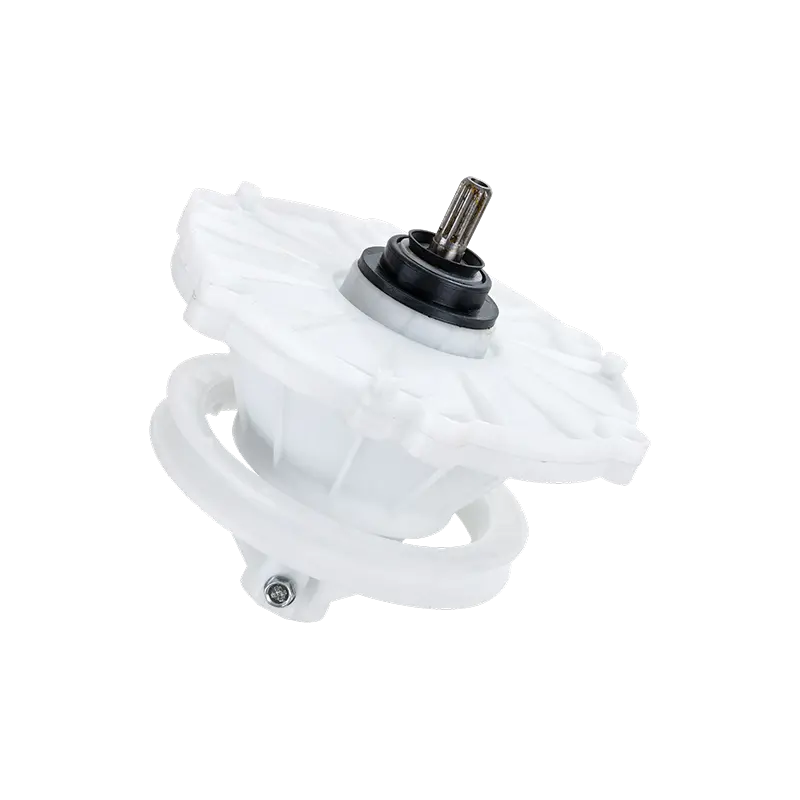

 +86-574-63256717 /63267914
info@gaite.cn
+86-574-63256717 /63267914
info@gaite.cn  gaite@gaite.cn
 No. 208 Miaoshan Road, Shiyan Village, Henghe Town, Cixi City, Ningbo City, Zhejiang Province, China