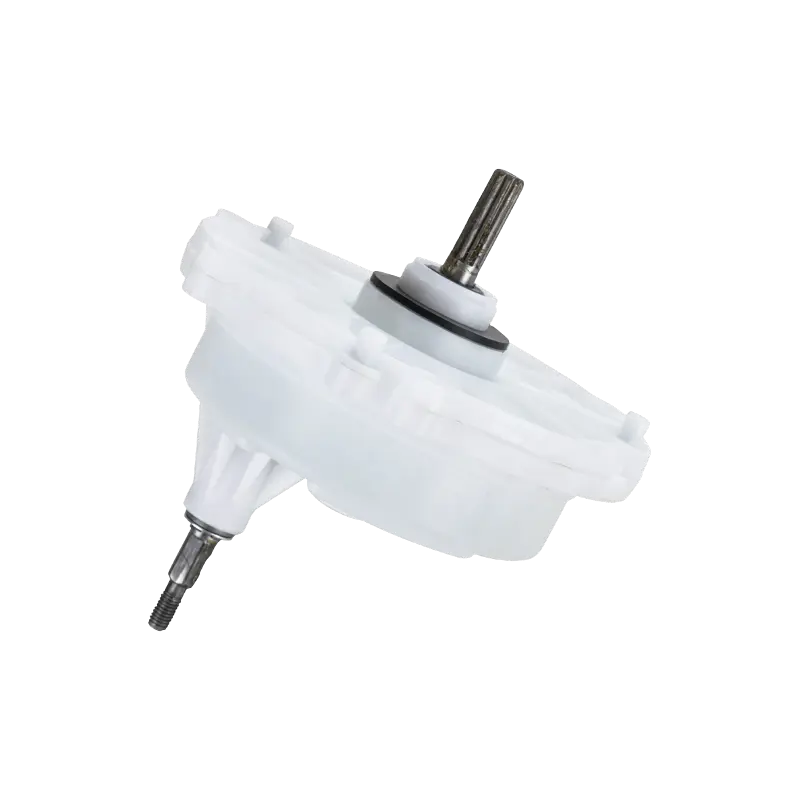
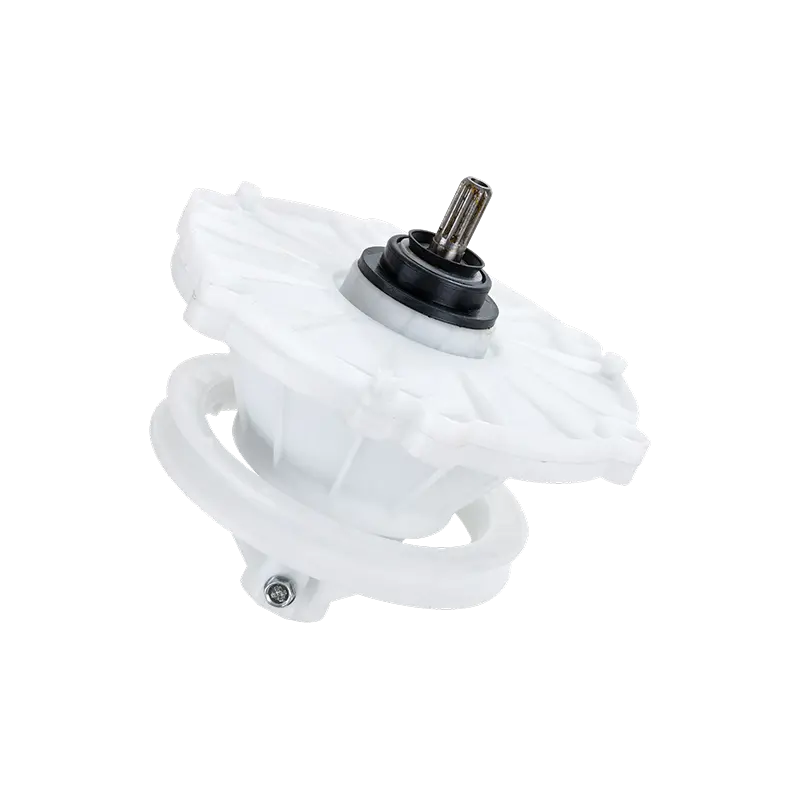
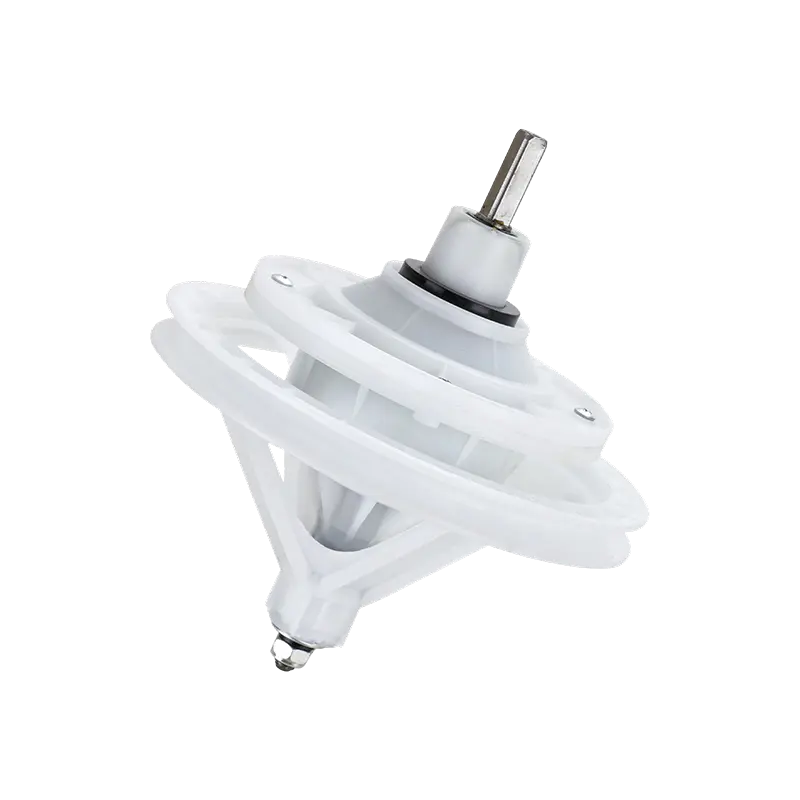
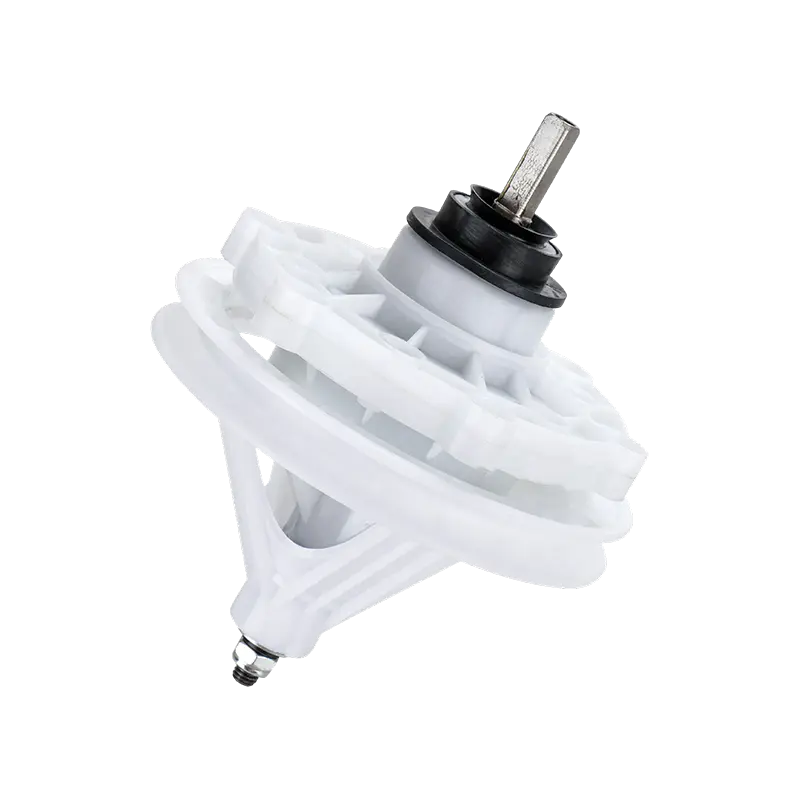
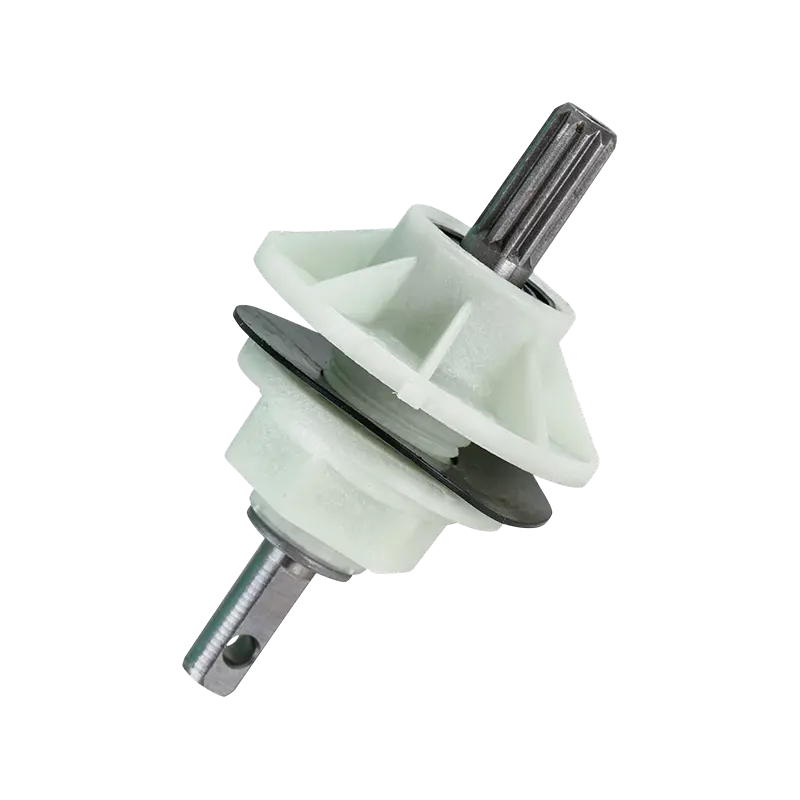
The Washing Machine Gear Case is a key transmission component of semi-automatic agitator washing machines, responsible for converting the high-speed rotation of the motor into low-speed, high-torque output, driving the agitator to efficiently move clothes and water flow. This gear case design combines durability and cost advantages, is suitable for long-term operation in humid environments, and provides reliable power for users who value economy and stability.
Product Features Efficient Power Transmission: Through a precision gear combination, it converts the high-speed rotation of the motor into the low-speed, high-torque power required by the agitator, achieving a uniform washing effect. Lightweight Structure: The weight of the gear case is only one-third of traditional metal gear devices, helping to reduce the weight of the whole machine and transportation cost. High-Durability Materials: Made of engineering plastics (POM/reinforced nylon), combining strength and wear resistance while effectively reducing production cost. Maintenance-Free Design: Gears are self-lubricating, requiring no additional lubricating oil or seals, reducing daily maintenance work and avoiding oil leakage problems.
Application Scenarios Core transmission system of semi-automatic agitator washing machines. Power output devices of household and light commercial washing machines. Washing equipment used in high-humidity or water-rich environments. Markets with high requirements for durability and cost efficiency.
GT007
1
Ø166.5mm (5 holes)
2
64.5mm
3
39mm
4
35mm (11Z45°T.H:39mm)
5
13.5mm
6
Ø11.6mm
7
Ø34
8
9
9
ratio: 1:3.28
Q: Do you have any international quality certifications for your products?
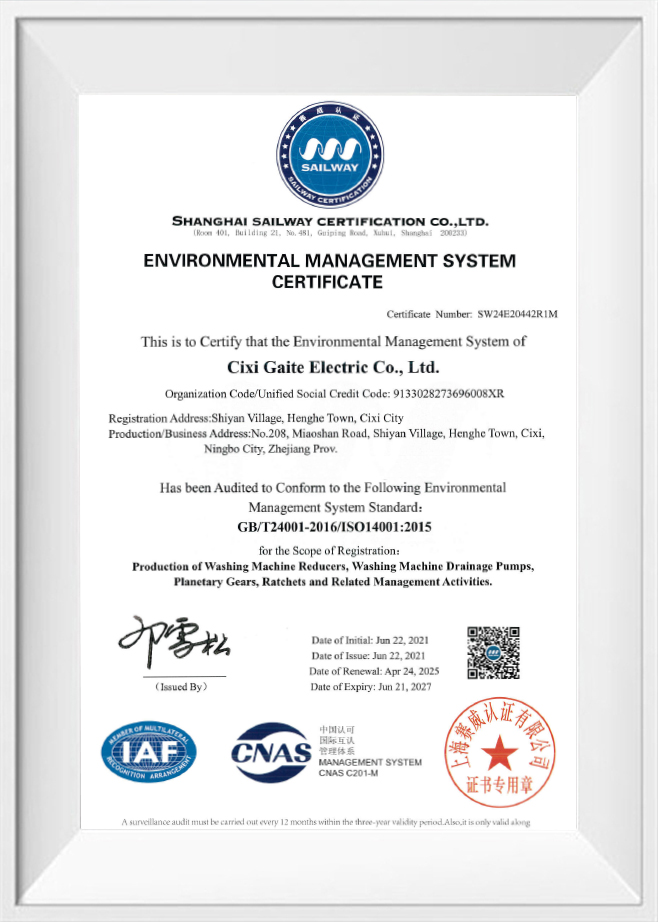
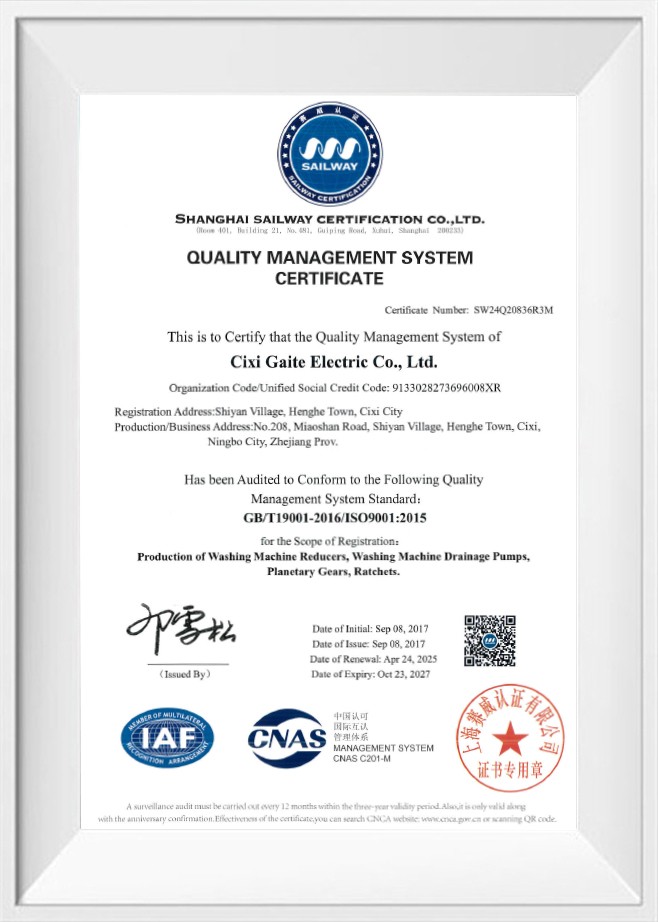
Yes, our company’s management system and product quality control process have passed ISO9001 international quality management system certification, all production links follow standardized quality inspection rules.
Q: What is the scale of your production plant?
Our production base spans over 10,000 square meters, equipped with standardized production workshops and independent quality inspection zones to support large-volume order production.
Q: Where is your factory located? Is the transportation convenient for bulk order delivery?
Our factory is situated in Ningbo, Zhejiang Province. We enjoy superior geographical advantages with seamless land, sea and air transportation, which ensures efficient and on-time shipment for global orders.
Q: How long has your factory been in the washing machine accessories industry?
We have specialized in manufacturing washing machine accessories since 2002, with nearly two decades of rich industry experience.
Q: What payment terms do you accept?
Trade terms such as FOB and CIF will be confirmed along with the quotation. For mass production, we normally require a 30% advance deposit, with the balance to be paid against a copy of the bill of lading. We mainly accept T/T, and L/C is also negotiable.
Q: Are you a factory or a trading company?
We are a direct manufacturer with independent production capacity, and we have a professional international sales team.
Q: Can you provide samples?
Yes. In-stock samples can be delivered within 3 days, while customized samples will take 7 to 10 days.
Q: How soon can I get your reply after sending an inquiry?
We value every inquiry we receive. We will reply to you within 12 hours upon receipt of your inquiry.
About Us
Cixi Gaite Electric Co., Ltd.
Founded in 2002, GAITE is a China Washing Machine Gear Case Supplier and Wholesale Washing Machine Gear Case Factory based in Ningbo, Zhejiang. The company specializes in the R&D and manufacturing of core washing machine components, including gear reducers and synchronizers, providing reliable component solutions for OEM manufacturers and aftermarket applications.
With years of development, GAITE now operates a modern production base of approximately 10,000 m², supported by stable production capacity and mature manufacturing processes. Committed to quality, GAITE continuously optimizes product performance and structural design, providing customers with cost-effective component solutions.
A washing machine gear case is the structural enclosure that surrounds and supports the internal gear train of the drivetrain assembly, providing the bearing bores, mounting bosses, and sealing surfaces that keep the gear mechanism correctly aligned while shielding it from external moisture. Unlike the complete functional drivetrain assembly, a washing machine gear caserefers specifically to the molded or cast housing component itself, typically supplied as two mating halves that are fastened together around the gear train during assembly. The case carries the mechanical loads generated by the meshing gears and transmits them to the appliance chassis through its mounting points, which makes its material selection and structural design directly relevant to overall drivetrain reliability.
Because the gear case is a load-bearing structural part rather than a moving component, its performance is judged primarily by dimensional stability under thermal and mechanical stress, resistance to cracking or deformation at fastener points, and its ability to dampen gear meshing noise rather than by rotational characteristics. A washing machine gear case that maintains tight bearing bore tolerances across its service life helps preserve correct gear mesh alignment, which in turn supports consistent torque transfer and reduces abnormal wear at the tooth contact surfaces. Material choice, wall thickness and rib design, and the case's split-line sealing arrangement are generally the three factors that most directly distinguish one gear case design from another.
This category page brings together the common material types and structural configurations used in washing machine gear case production, their general working principles, application-specific selection considerations for OEM production and aftermarket replacement, and maintenance guidance relevant to case inspection and reassembly. The content is organized to help engineers, procurement teams, and maintenance technicians evaluate gear case options for a given washing machine drivetrain platform.
2. Common Types and Structural Characteristics
Washing machine gear case products are generally distinguished by the material and molding or casting process used to form the housing, along with the split-line arrangement used to enclose the internal gear train. The four configurations below cover most gear case designs currently used across washing machine drivetrain platforms.
(1) Injection-Molded Engineering Plastic Case
Reinforced engineering plastic, commonly a glass-fiber-filled nylon or similar polymer, is injection molded into the case shape with integral ribs and bosses to add stiffness without adding significant weight. This approach generally reduces overall drivetrain weight and provides useful noise-damping characteristics compared to a rigid metal shell.
(2) Die-Cast Metal Case
Aluminum alloy or zinc alloy die casting produces a case with higher structural rigidity and generally better dimensional stability under thermal cycling than a plastic equivalent. This approach is often selected for higher-torque or higher-duty drivetrain platforms where bearing bore precision under sustained load is a priority.
(3) Two-Piece Split Case
The two-piece split case design, common to both plastic and metal gear cases, joins an upper and lower shell along a horizontal split line that passes through the bearing bore centerlines. This arrangement simplifies gear train installation during assembly and allows for internal inspection or service without disturbing the case's external mounting interface.
(4) One-Piece Molded Case with Access Cover
Some designs use a single molded or cast main body with a smaller separate access cover rather than two roughly equal halves. This configuration can improve overall structural continuity around the bearing bores since fewer load paths cross the split line, though it generally requires a different gear train assembly sequence during production.
Table 1: General comparison of common washing machine gear case configurations
Case Type
Primary Material
Relative Weight
Typical Application
Injection-Molded Plastic
Reinforced engineering polymer
Lower
Standard domestic platforms
Die-Cast Metal
Aluminum or zinc alloy
Higher
Higher-torque platforms
Two-Piece Split
Plastic or metal
Depends on material
General assembly convenience
One-Piece with Access Cover
Plastic or metal
Depends on material
Structural continuity priority
3. Structural Role and Relative Weight by Material Type
The structural role of a washing machine gear case centers on maintaining precise bearing bore alignment and mounting stability while transmitting the reaction loads generated by the internal gear train to the appliance chassis. Because the case does not rotate or directly contact water inside the wash tub, its engineering priorities differ from the rotating shaft and reversing gear components discussed elsewhere in this component family; rigidity, dimensional stability, and vibration damping are the primary concerns rather than rotational wear resistance.
The chart below illustrates the general relative weight of a comparably sized washing machine gear case across the four material and construction approaches described in the previous section. These figures represent commonly observed relative comparisons across current washing machine drivetrain platforms and are intended as a general reference rather than a fixed specification for any individual product. Reviewing this comparison helps clarify why injection-molded plastic cases are frequently selected when overall appliance weight and shipping cost are priorities, while die-cast metal cases are more often specified when maximum structural rigidity under sustained torque is the primary requirement. It also explains why the two-piece split and one-piece access-cover configurations are generally evaluated on assembly convenience and structural continuity rather than on weight alone, since either construction style can be produced in either material. Engineers evaluating a washing machine gear case for a new platform typically begin by weighing the relative importance of weight, rigidity, and moisture resistance before narrowing down a specific material and construction combination from this comparison.
As the chart indicates, injection-molded plastic gear cases generally sit at the lower end of the relative weight range, which is consistent with the density advantage of engineering polymers over cast metal alloys of comparable wall thickness. Die-cast metal cases sit at the higher end, reflecting the greater density of aluminum and zinc alloys, though this additional mass generally comes paired with meaningfully higher structural rigidity and thermal dimensional stability. The two-piece split and one-piece access-cover constructions fall into a moderate range in this comparison because their relative weight depends primarily on which base material has been selected rather than on the split-line arrangement itself. It is worth noting that weight is only one input among several when specifying a gear case for a given platform; structural rigidity, noise damping, and moisture resistance also factor into the final selection, and these are covered in the sections that follow. Procurement teams sourcing a washing machine gear casefor a specific appliance platform should treat this chart as a general starting reference and confirm the exact material requirement against the target torque loading and overall appliance weight target. Because actual weight figures vary with case size and wall thickness even within a single material category, working from the specific platform specification during sourcing remains the most reliable approach.
4. Dimensional Stability Across Thermal Cycling
Because a washing machine gear case must maintain precise bearing bore alignment throughout its service life, its dimensional stability under repeated thermal cycling is a meaningful engineering consideration, particularly as the appliance experiences temperature swings between ambient conditions and the mildly elevated temperatures generated during extended operation. Engineering plastics generally exhibit a higher coefficient of thermal expansion than cast metal alloys, which means a plastic gear case can experience proportionally greater dimensional movement across a given temperature range unless the material formulation and rib design are specifically engineered to limit this effect.
The line chart below presents an illustrative dimensional stability index across an increasing number of thermal cycles for injection-molded plastic cases, die-cast metal cases, and glass-fiber-reinforced plastic cases formulated specifically to reduce thermal expansion. The index reflects a general, relative measure of how well bearing bore alignment is maintained rather than a guaranteed dimensional tolerance for any specific product, since actual results depend on the specific polymer or alloy formulation, wall thickness, and rib geometry used in a given case design. This comparison is intended to help engineering and maintenance teams understand why reinforced plastic formulations are frequently specified over standard unfilled polymers when dimensional stability is a priority, and why die-cast metal cases remain a common choice for platforms where thermal cycling is more frequent or pronounced. Reading the chart from left to right shows how the stability gap between material types tends to widen as thermal cycle count increases, a pattern consistent with cumulative microstructural changes that affect unreinforced polymers more noticeably than reinforced polymers or metal alloys. This widening gap is one of the key reasons that higher-duty washing machine platforms increasingly specify glass-fiber-reinforced plastic or die-cast metal gear cases rather than a standard unreinforced polymer equivalent.
The die-cast metal line declines the most gradually across the thermal cycle range shown, reflecting the inherently lower coefficient of thermal expansion of aluminum and zinc alloys compared to polymer materials. The glass-fiber-reinforced plastic line shows a steeper decline than the metal case but a considerably more gradual one than the standard unreinforced polymer, consistent with the reinforcing fibers constraining the resin matrix and limiting overall dimensional movement across repeated temperature swings. The standard unreinforced plastic line declines most steeply in this comparison, which corresponds to unfilled polymers having comparatively less internal reinforcement to resist cumulative dimensional drift at the bearing bore locations. It is worth emphasizing that this chart represents a general relative comparison rather than a certified tolerance specification, since real-world dimensional stability also depends heavily on rib geometry, wall thickness consistency, and the specific polymer or alloy grade selected. For OEM production lines specifying a new washing machine gear case, material selection should be matched to the expected thermal cycling profile of the target appliance rather than defaulting to a single material across all product tiers. For aftermarket replacement, technicians servicing higher-duty or frequently used machines often find that specifying a reinforced plastic or die-cast metal case, where the mounting interface allows for it, reduces the frequency of alignment-related gear noise complaints compared to a baseline unreinforced polymer replacement.
5. Application Scenarios and Selection Priorities
Selecting the correct washing machine gear case for a given application involves weighing several structural factors against the specific demands of the target drivetrain platform. For OEM production, the case must be specified alongside the internal gear train and output shaft, since bearing bore dimensions, mounting boss placement, and split-line sealing arrangement are interdependent across these components. For aftermarket replacement, the priority shifts toward matching the exact bearing bore layout, mounting footprint, and case material of the original component to avoid introducing misalignment or noise after reassembly.
The bar chart below presents a general selection priority scoring across five common evaluation factors for washing machine gear case components: structural rigidity, noise damping, moisture resistance, weight, and manufacturing cost efficiency. These scores reflect a generalized weighting commonly applied during component evaluation rather than a fixed formula, since actual priority ranking shifts depending on whether the case is intended for a compact domestic platform or a larger-capacity, higher-torque appliance. Reviewing this chart before finalizing a sourcing decision helps procurement and engineering teams align on which factors deserve the most scrutiny during supplier evaluation and sample testing. It also provides a useful framework for comparing technical proposals from different component sources on a like-for-like basis rather than focusing on a single attribute in isolation. For most washing machine platforms, structural rigidity and moisture resistance tend to carry a disproportionately high weight relative to their apparent simplicity, because deviations in these areas commonly lead to gear misalignment or internal corrosion after extended use.
As shown in the chart, structural rigidity and moisture resistance score at or near the top of the general priority ranking, closely followed by noise damping, while weight and manufacturing cost efficiency, though still relevant, generally carry somewhat less weight in a well-balanced evaluation of a gear case component. This pattern reflects the practical reality that a washing machine gear case allowing gear misalignment or moisture ingress tends to generate downstream drivetrain problems well before secondary factors such as case weight become operationally significant. Engineers and buyers evaluating a new gear case supplier commonly use a weighting framework similar to this one to structure sample testing, prioritizing bearing bore dimensional inspection and split-line seal checks alongside material verification rather than treating cost as the primary differentiator. For platforms intended for higher-torque or more frequent-use applications, structural rigidity often deserves even greater emphasis than shown in this general chart, since sustained higher loading increases the consequences of even minor case deflection at the bearing bores. Ultimately, the relative weighting of these five factors should be adjusted to reflect the specific torque loading, operating environment, and reliability expectations of the target washing machine drivetrain platform.
6. Performance Profile Comparison Across Case Materials
Beyond individual metrics such as weight or thermal stability alone, it is often useful to view a washing machine gear case's overall performance profile across several dimensions at once. The radar chart below compares an injection-molded plastic case against a die-cast metal case across five attributes: structural rigidity, noise damping, lightweight construction, moisture resistance, and cost efficiency. This type of multi-attribute view helps engineering teams visualize trade-offs rather than focusing on a single specification in isolation, since no single case material scores highest across every category simultaneously. The scoring shown here is illustrative and intended to represent general tendencies observed across common washing machine platforms, rather than a certified benchmark for any individual product. Comparing two case materials on the same radar frame also makes it easier to communicate design trade-offs to non-technical stakeholders during a platform review or supplier discussion.
The overlapping polygons in the radar chart illustrate that the injection-molded plastic case generally scores higher on noise damping, lightweight construction, and cost efficiency, consistent with the inherent damping and density characteristics of engineering polymers discussed earlier in this page. The die-cast metal case, in comparison, tends to score more favorably on structural rigidity and moisture resistance, largely because metal alloys resist deflection under load more effectively and are less prone to moisture absorption than polymer materials over extended service periods. This trade-off pattern is fairly typical when comparing polymer and metal structural components across many mechanical applications, not only within washing machine drivetrains. This comparison reinforces a recurring theme across this category page: no single washing machine gear case material is universally superior, and the correct choice depends on matching the case's performance profile to the specific torque loading, weight target, and environmental exposure of the appliance platform under consideration. Engineering teams reviewing a new washing machine platform, or evaluating a component supplier's proposed gear case material, can use a radar-style comparison such as this one to quickly identify which trade-offs are being accepted before committing to a final design.
7. Structural Overview of a Typical Gear Case
To make the structural discussion above easier to visualize, the isometric diagram below outlines the general layout of a typical two-piece washing machine gear case, showing the upper case half, the lower case half, the bearing bore bosses that support the internal gear shafts, and the fastener bosses that clamp the two halves together along the split line. This simplified structural view is intended for general reference and orientation rather than as a precise engineering drawing of any specific product. Viewing the case as a set of mating structural halves helps clarify why split-line sealing and fastener boss placement are just as important to overall case performance as the base material selection discussed in earlier sections. Understanding this layered structure also makes it easier to interpret the selection discussion covered previously, since each labeled zone in the diagram corresponds to a different evaluation priority from Section 5.
Reading the diagram from top to bottom follows the physical assembly sequence of a typical two-piece gear case, beginning with the upper case half that is fitted over the gear train and ending with the fastener bosses located near the lower edge that clamp the two halves securely together. The bearing bore bosses shown near the top of the upper half provide the precise circular seats that support the gear shaft bearings, and their dimensional accuracy directly determines gear mesh alignment, which is why bearing bore precision was highlighted as a top evaluation priority in Section 5. The split line seal running along the horizontal joint between the two case halves prevents moisture and detergent residue from entering the internal cavity, and its condition is closely tied to the moisture resistance discussion in Section 3. The lower case half generally mirrors the upper half's bearing bore features to complete the shaft support, while also often incorporating the case's primary mounting interface to the appliance chassis. The fastener bosses distributed around the case perimeter must be adequately reinforced in the surrounding material to resist repeated clamping loads without cracking, particularly in plastic case designs where boss reinforcement ribs are commonly added around each fastener location. Viewing the gear case as a matched pair of structural halves, rather than as a single generic enclosure, is a useful mental model when comparing sourcing options or diagnosing a field failure related to misalignment or leakage.
8. Manufacturing Considerations for OEM and Aftermarket Supply
Consistent manufacturing process control has a direct bearing on how well a washing machine gear case performs once installed, particularly with respect to bearing bore dimensional accuracy, split-line flatness, and material consistency across production batches. OEM manufacturers generally require tight batch-to-batch consistency because even small dimensional shifts in bearing bore position can affect gear mesh alignment once the case is paired with a gear train sourced separately for the same platform. Aftermarket suppliers face a related but distinct challenge, since a replacement gear case must match the original equipment bearing bore layout, mounting footprint, and split-line sealing arrangement closely enough to avoid introducing new noise or moisture ingress issues after installation, even when the original appliance model is no longer in current production.
Cixi Gaite Electric Co., Ltd., established in 2002 and based in Ningbo, Zhejiang, has focused its manufacturing activity specifically on core washing machine drivetrain components, including gear reducers, synchronizers, and the structural gear cases that house them, for both OEM manufacturers and aftermarket applications. Operating from a production base of approximately 10,000 square meters, the company has built its manufacturing processes around the specific bearing bore precision and split-line sealing requirements associated with washing machine gear case components, including the rigidity and moisture resistance considerations discussed throughout this page. This long-standing focus on a narrow, mechanically related product family, rather than a broad general-purpose component catalog, has supported consistent process control across production runs and allows for closer coordination with customers on structural and material specification during the sourcing stage.
For procurement teams evaluating a washing machine gear case supplier, it is generally useful to request sample units for bearing bore dimensional inspection, split-line flatness checks, and fastener boss load testing before committing to a production order, regardless of which manufacturer is under consideration. Reviewing bore concentricity, split-line surface finish, and rib and boss integrity across a small batch of samples provides a more reliable indication of expected field performance than reviewing a technical drawing alone.
9. Maintenance and Installation Guidance
Proper installation and periodic inspection help extend the service life of a washing machine gear case and reduce the likelihood of premature misalignment or moisture-related wear. The following practices are commonly recommended by maintenance technicians working on washing machine drivetrain platforms.
Confirm that the replacement gear case's bearing bore layout, mounting footprint, and material match the original component before installation, since a mismatched bore layout is a common cause of gear misalignment.
Inspect the split-line gasket or sealing surface for damage before reassembly, since a compromised split-line seal can allow moisture ingress into the case even when the bearing bores are in good condition.
Check fastener bosses for cracking around the mounting screw locations, particularly on plastic case designs, since repeated over-tightening can gradually weaken the surrounding material.
Torque the case fasteners evenly and to the specified value rather than over-tightening, since uneven or excessive clamping force can distort the split line and affect bearing bore alignment.
Periodically check for unusual gear noise or visible moisture at the case split line during operation, which can indicate early-stage seal wear before a more significant alignment issue develops.
Keep a record of installation date and observed operating conditions, particularly ambient temperature swings and usage frequency, to help anticipate replacement intervals for future maintenance planning.
Following these steps does not eliminate the possibility of component wear over time, since all gear case components experience gradual wear under normal operating conditions, but consistent installation practice and periodic inspection generally help identify early warning signs before a failure disrupts appliance operation.
10. Frequently Asked Questions
(1) What is the difference between a gear case and a gear box on a washing machine?
A gear case refers specifically to the structural housing component that encloses and supports the internal gear train, while a gear box generally refers to the complete packaged unit that includes the gear case along with the internal gear train, synchronizer, and output shaft assembly. In practice, a gear case is one structural component within a complete gear box assembly.
(2) How do I know which gear case material my washing machine platform needs?
Identifying the appropriate material generally starts with the target torque loading and expected duty cycle of the appliance platform, since injection-molded plastic and die-cast metal cases correspond to different structural and weight trade-offs as outlined in Sections 3 and 6 of this page. Checking the original component's bearing bore layout, mounting footprint, and material grade against manufacturer reference data is the most reliable way to confirm an exact match before ordering a replacement.
(3) Does gear case material significantly affect long-term gear alignment?
Gear case material is one of several factors affecting long-term alignment, alongside installation quality, thermal cycling frequency, and bearing bore precision at manufacture. As illustrated in Section 4, reinforced plastic and die-cast metal cases generally show a slower relative decline in dimensional stability compared to standard unreinforced plastic cases under similar thermal cycling conditions, though actual results vary by application.
(4) Can a cracked gear case be repaired instead of replaced?
Minor surface damage away from bearing bores or fastener bosses may sometimes be addressed without full replacement, but cracking near a bearing bore or fastener boss generally compromises structural integrity in a way that makes full case replacement the more reliable option, since these areas directly affect gear alignment and clamping security.
(5) What information should I provide when sourcing a washing machine gear case from a manufacturer?
Useful information typically includes the appliance platform or model reference, bearing bore layout and spacing, mounting footprint dimensions, expected torque loading, and preferred material category, since these details help a manufacturer recommend an appropriate case material and structural design.


 English
 عربى


 +86-574-63256717 /63267914
info@gaite.cn
 gaite@gaite.cn
 No. 208 Miaoshan Road, Shiyan Village, Henghe Town, Cixi City, Ningbo City, Zhejiang Province, China
