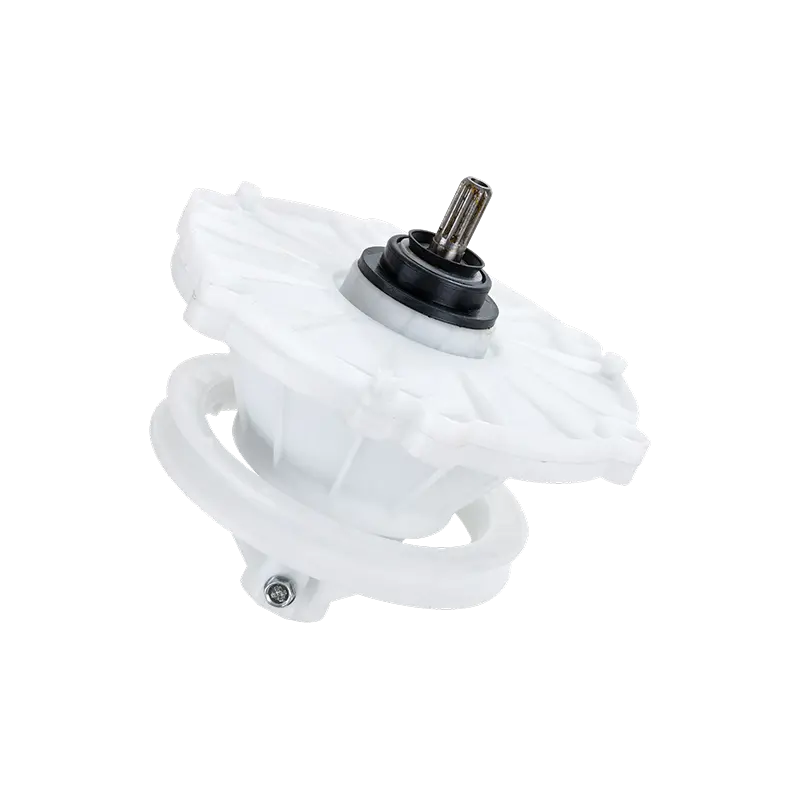
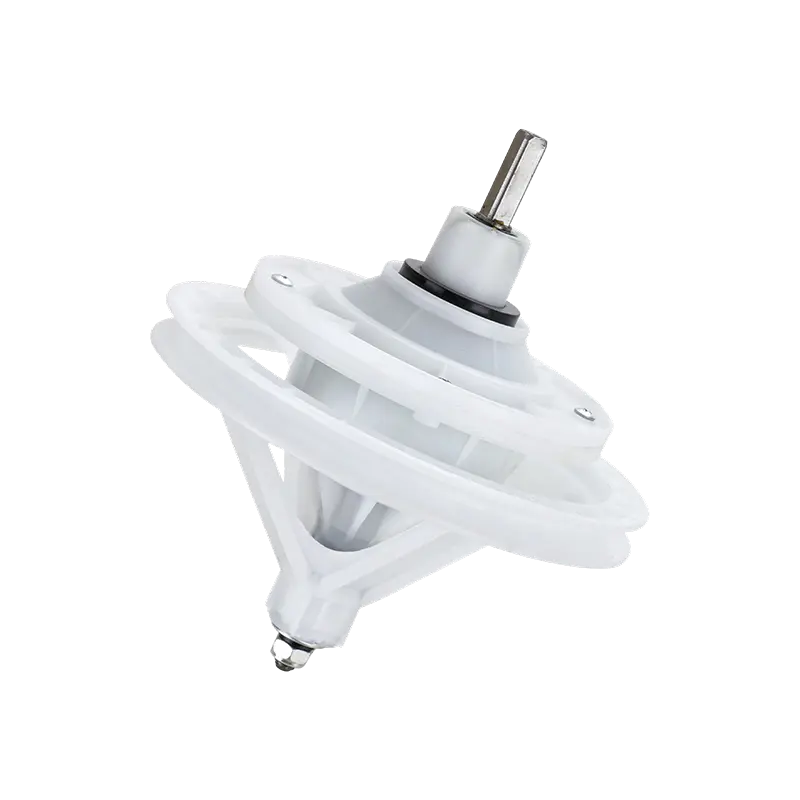
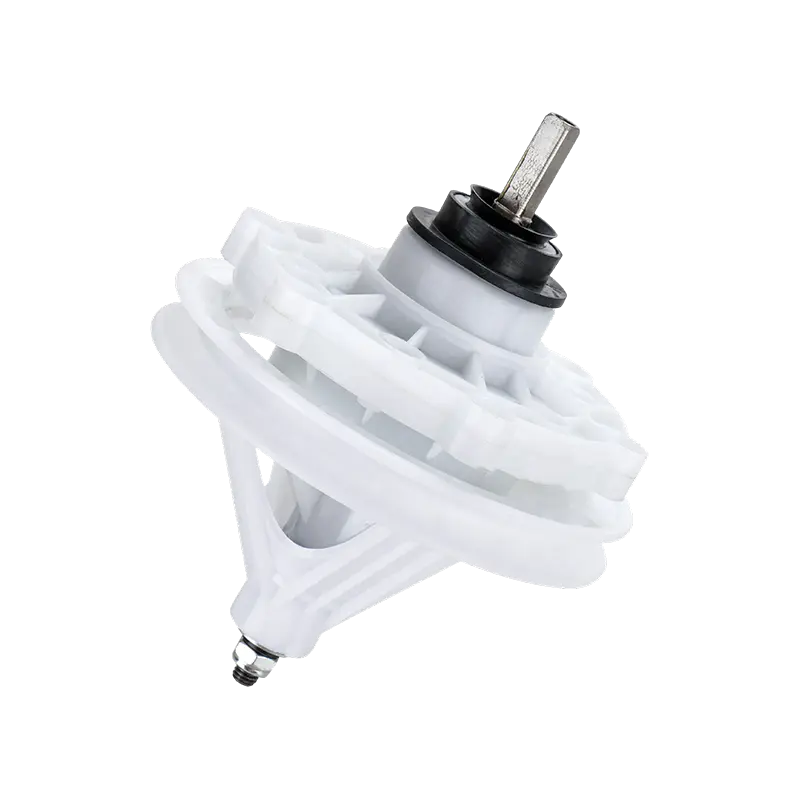
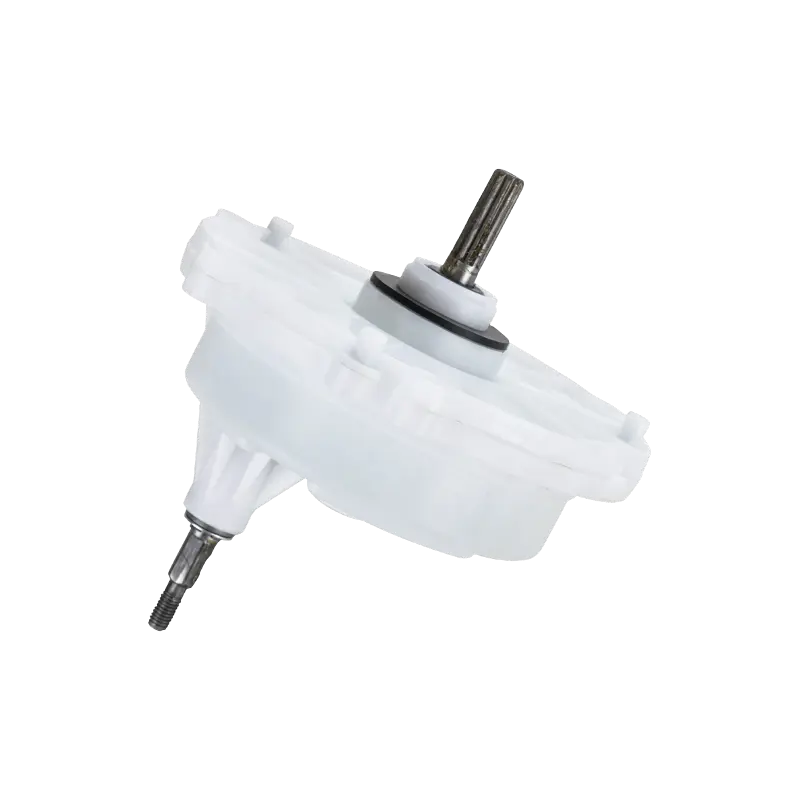
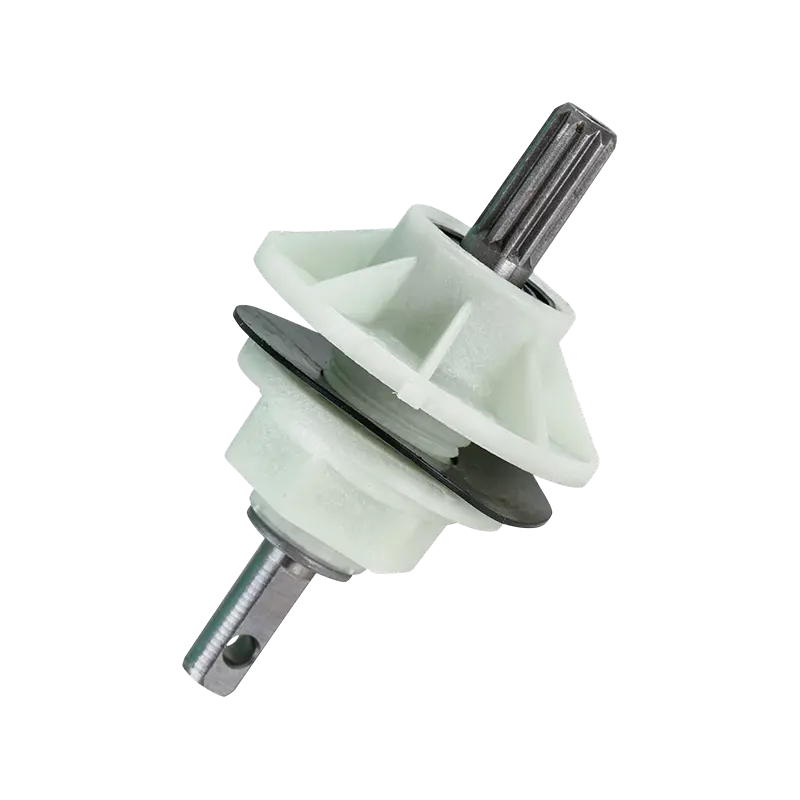
The Twin-tub Washing Machine Reducer is the core power device of semi-automatic twin-cylinder washing machines, responsible for converting the high-speed rotation of the motor into a low-speed, high-torque output suitable for the agitator. Through precise gear meshing, this reducer can operate stably for a long time in humid environments and provide reliable power for washing. It is an ideal choice for semi-automatic washing machines that focus on cost performance and durability.
Product Features Efficient Power Transmission: Adopts a planetary gear structure, accurately converting the high-speed rotation of the motor into low-speed, high-torque power required for washing. Cost-Optimized Materials: Uses high-strength engineering plastics (such as POM or reinforced nylon) instead of traditional metal gears, reducing material cost while maintaining wear resistance and service life. Maintenance-Free: Plastic gears are self-lubricating, eliminating the need for lubricating oil and seals, avoiding oil leakage problems, and reducing maintenance burden. Lightweight Design: The whole unit weighs only one-third of a metal reducer, helping to reduce the overall weight of the washing machine and transportation cost.
Application Scenarios Agitation and spin drive systems of semi-automatic twin-tub washing machines. Household and commercial washing machines used in high-humidity or high-water environments. Markets and products with high requirements for cost performance and long-term durability.
GT002
1
Ø140mm
2
Ø167mm (6 holes)
3
24.5mm (11Z 45°T.H:29.7mm)
4
25.5mm
5
63mm
6
117.5mm
7
ratio: 1:6
Q: Do you have any international quality certifications for your products?
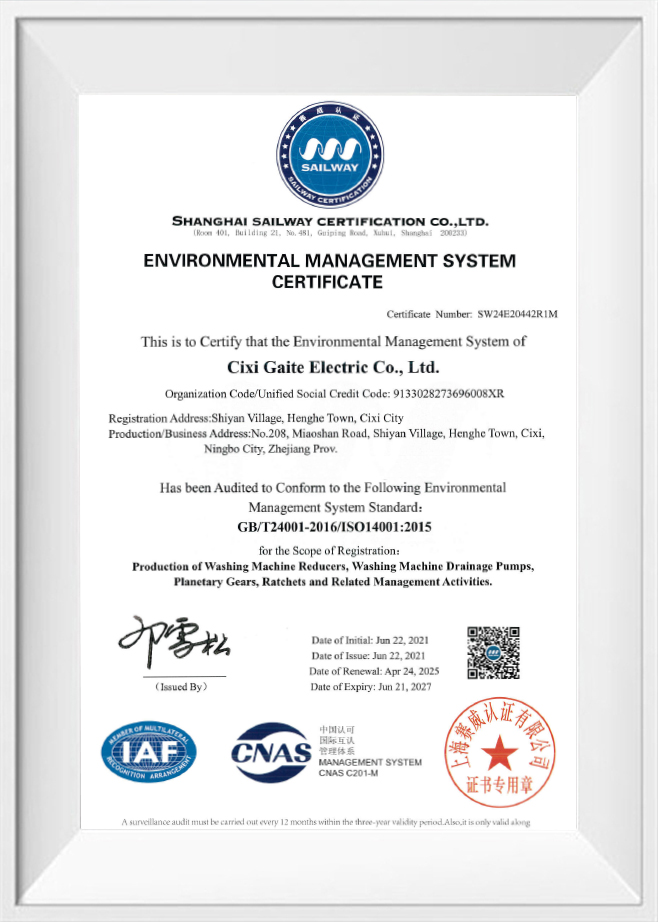
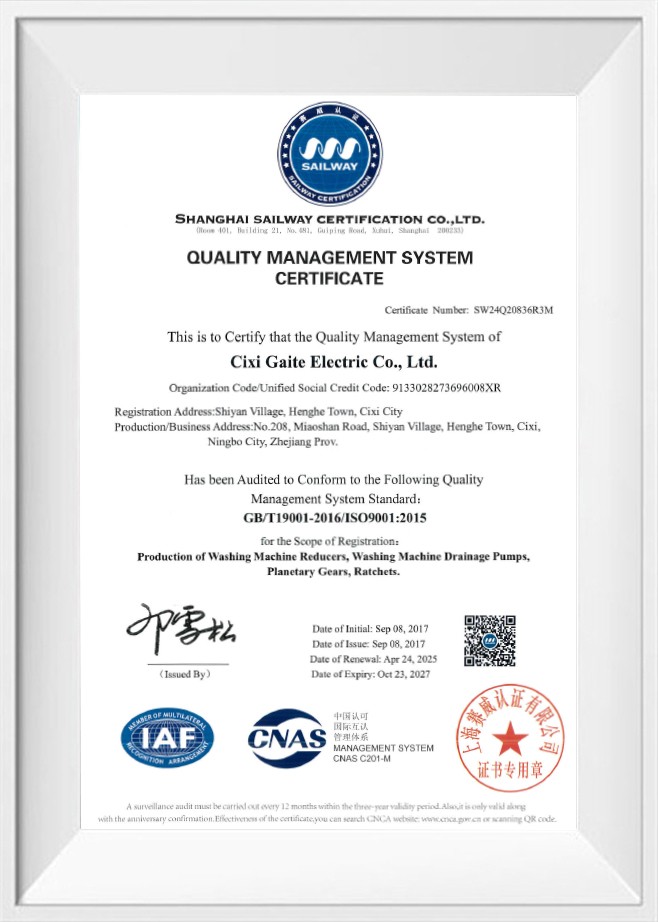
Yes, our company’s management system and product quality control process have passed ISO9001 international quality management system certification, all production links follow standardized quality inspection rules.
Q: What is the scale of your production plant?
Our production base spans over 10,000 square meters, equipped with standardized production workshops and independent quality inspection zones to support large-volume order production.
Q: Where is your factory located? Is the transportation convenient for bulk order delivery?
Our factory is situated in Ningbo, Zhejiang Province. We enjoy superior geographical advantages with seamless land, sea and air transportation, which ensures efficient and on-time shipment for global orders.
Q: How long has your factory been in the washing machine accessories industry?
We have specialized in manufacturing washing machine accessories since 2002, with nearly two decades of rich industry experience.
Q: What payment terms do you accept?
Trade terms such as FOB and CIF will be confirmed along with the quotation. For mass production, we normally require a 30% advance deposit, with the balance to be paid against a copy of the bill of lading. We mainly accept T/T, and L/C is also negotiable.
Q: Are you a factory or a trading company?
We are a direct manufacturer with independent production capacity, and we have a professional international sales team.
Q: Can you provide samples?
Yes. In-stock samples can be delivered within 3 days, while customized samples will take 7 to 10 days.
Q: How soon can I get your reply after sending an inquiry?
We value every inquiry we receive. We will reply to you within 12 hours upon receipt of your inquiry.
With years of development, GAITE now operates a modern production base of approximately 10,000 m², supported by stable production capacity and mature manufacturing processes. Committed to quality, GAITE continuously optimizes product performance and structural design, providing customers with cost-effective component solutions.
A twin-tub washing machine reducer is the gearbox assembly positioned between the motor and the pulsator or agitator interface on semi-automatic washing machines that use two separate compartments for washing and spinning. The twin-tub washing machine reducerlowers the relatively high rotational speed of the motor while increasing output torque, and in most designs also converts continuous rotation into the reversing oscillation needed to drive the wash-side pulsator. Because the wash tub and spin tub operate independently on a twin-tub platform, the reducer serving the wash side is engineered specifically around reversing-load characteristics rather than the continuous one-directional spin duty seen on the spin-tub side.
Internally, a typical twin-tub washing machine reducer houses a gear train, an output shaft with a seal and bushing arrangement, and in many models an integrated synchronizer or reversing mechanism that periodically changes rotation direction to create the pulsator's back-and-forth stroke. The housing itself is generally sealed and grease-packed to protect the gear train from moisture generated inside the wash compartment, since the reducer sits close to the tub floor where splash exposure is highest. Gear ratio, tooth geometry, housing sealing, and output shaft interface are the four structural elements that most directly determine how a given twin-tub washing machine reducer performs across its service life.
This category page brings together the common structural types of twin-tub washing machine reducer assemblies, their working principles, application-specific selection considerations for OEM production and aftermarket replacement, and maintenance guidance intended to help extend service life. The content is organized to support engineers, procurement teams, and maintenance technicians in identifying the correct reducer configuration for a given twin-tub appliance platform.
2. Common Types and Structural Characteristics
Reducer designs used on twin-tub washing machines vary primarily according to the gear train arrangement used to achieve the required speed reduction and torque increase. The four configurations below cover most wash-side reducer designs found on current semi-automatic platforms.
(1) Helical Gear Reducer
Helical gear reducers use angled gear teeth that engage progressively rather than all at once, which generally reduces meshing noise and vibration compared to straight-cut spur gears. This configuration is common on mid-range twin-tub platforms where a moderate reduction ratio and reasonably smooth operation are both priorities.
(2) Worm Gear Reducer
Worm gear reducers achieve a higher reduction ratio within a compact housing by meshing a worm screw against a worm wheel. This arrangement is well suited to twin-tub platforms with limited housing space beneath the wash tub, though the sliding contact between worm and wheel generally generates more friction than a helical gear pair of comparable size.
(3) Compound Spur Gear Reducer
Compound spur gear reducers stack two or more straight-cut gear stages to achieve the target reduction ratio using simpler, more economical tooth geometry. This configuration is frequently paired with a separate synchronizer component to generate the reversing pulsator motion, keeping the reducer itself focused purely on speed and torque conversion.
(4) Integrated Reducer-Synchronizer Assembly
Some twin-tub platforms combine the gear reduction stage and the reversing synchronizer mechanism into a single housing. This integrated approach reduces the number of separate components on the appliance drivetrain and can simplify assembly, though it requires closer coordination between gear design and reversing mechanism design during development.
Table 1: General structural comparison of common twin-tub washing machine reducer types
Reducer Type
Gear Arrangement
Relative Noise Level
Typical Application
Helical Gear
Angled tooth mesh
Lower
Mid-range twin-tub
Worm Gear
Worm and wheel
Moderate
Compact-housing platforms
Compound Spur
Multi-stage straight-cut
Moderate to higher
Economical platforms
Integrated Reducer-Synchronizer
Gear train plus reversing mechanism
Depends on gear stage
Space-constrained platforms
3. Working Principle and Reduction Ratio Characteristics
The working principle of a twin-tub washing machine reducer centers on converting the motor's relatively fast, low-torque rotation into a slower, higher-torque output suitable for driving the wash-side pulsator or agitator. Inside the housing, one or more meshing gear stages progressively reduce rotational speed at each stage while multiplying torque according to the gear ratio at that stage. Where a reversing synchronizer is integrated or attached to the reducer output, an additional mechanism periodically interrupts and reverses the output rotation direction to produce the oscillating stroke that agitates water and fabric.
The chart below illustrates the general reduction ratio range typically associated with each of the four reducer configurations described in the previous section. These figures represent commonly observed mid-range values across current twin-tub platforms and are intended as a general reference rather than a fixed specification for any individual product. Reviewing this comparison helps explain why worm gear reducers are often selected when a compact housing must still deliver a relatively high reduction ratio, while helical and compound spur designs are more frequently used where a moderate ratio and smoother operation are the primary goals. It also clarifies why housing size, gear material, and lubrication strategy differ meaningfully across these reducer types, since a higher reduction ratio generally concentrates more sliding contact and heat generation within a smaller gear mesh area. Engineers evaluating a twin-tub washing machine reducer for a new platform typically begin by estimating the required output torque and pulsator stroke frequency before selecting a target ratio range from this comparison.
As the chart indicates, worm gear reducers generally cover the widest and highest reduction ratio range among the four configurations, which is consistent with their compact single-mesh design and ability to achieve a large ratio without stacking multiple gear stages. Compound spur reducers and integrated reducer-synchronizer assemblies fall into a mid-range band, reflecting a balance between ratio, mechanical simplicity, and manufacturing cost. Helical gear reducers generally sit toward the lower end of the typical range shown here, which is often an acceptable trade-off given their comparatively quieter operation. It is worth noting that reduction ratio is only one input among several when specifying a reducer for a twin-tub platform; output shaft torque capacity, housing sealing performance, and gear material wear resistance also factor into the final selection. Procurement teams sourcing a twin-tub washing machine reducer for a specific appliance platform should treat this chart as a general starting reference and confirm the exact ratio requirement against the target motor speed and desired pulsator stroke frequency. Because actual ratio requirements vary even within a single reducer category depending on tub capacity and motor rating, working from the specific drivetrain specification during sourcing remains the most reliable approach.
4. Gear Material Grades and Relative Tooth Wear Progression
Gear tooth material and heat treatment are among the most consequential decisions in twin-tub washing machine reducer design, since the gear train operates under repeated reversing loads, in a housing exposed to moisture and detergent residue, and often with limited lubrication replenishment over the appliance's service life. Three material approaches are commonly used across the industry: standard carbon steel gears, case-hardened steel gears where the tooth surface receives an additional hardening treatment while the core remains tough, and sintered alloy gears formed through a powder-metallurgy process. Each approach carries a different tooth wear progression curve as duty cycles accumulate, which helps explain why higher-duty twin-tub platforms tend to specify case-hardened gear sets even where the base tooth geometry is nearly identical to a standard carbon steel equivalent.
The line chart below presents an illustrative tooth wear index across an increasing number of duty cycles for the three material approaches described above. The wear index reflects a general, relative measure of tooth surface and meshing wear rather than a guaranteed lifespan figure for any specific product, since actual results depend on lubrication retention, moisture exposure, load frequency, and housing sealing quality. This comparison is intended to help engineering and maintenance teams understand why gear material selection becomes increasingly important as appliance duty cycles rise, and why aftermarket replacement intervals often differ meaningfully between standard steel and case-hardened gear variants. Reading the chart from left to right shows how the wear gap between material types widens progressively rather than remaining constant, a pattern commonly observed in reversing gear trains subject to repeated directional loading. This widening gap is one of the key reasons that mid- and higher-duty twin-tub washing machine platforms increasingly specify case-hardened or sintered alloy gear sets rather than a basic standard steel equivalent.
The standard steel line rises most steeply, reflecting faster tooth surface wear as reversing loads and meshing cycles accumulate at the gear contact points. The case-hardened steel line shows a moderated rise, consistent with the added surface hardness at the tooth flank while the gear core retains enough toughness to resist fatigue fracture under repeated reversing torque. The sintered alloy line remains flattest across the full cycle range in this comparison, corresponding to the more uniform density and controlled porosity achievable through the powder-metallurgy process when properly specified for this application. It is worth emphasizing that this chart represents a general relative comparison rather than a certified lifespan guarantee, since real-world gear wear also depends heavily on lubrication retention, housing seal integrity, and duty cycle frequency. For OEM production lines specifying a new twin-tub washing machine reducer, gear material should be matched to the expected duty profile of the target appliance rather than defaulting to a single material across all product tiers. For aftermarket replacement, technicians working on higher-duty or frequently used twin-tub machines often find that upgrading to a case-hardened gear set, where the housing and mounting interface allow for it, reduces the frequency of repeat gear-noise or slippage-related service calls compared to a baseline standard steel replacement.
5. Application Scenarios and Selection Priorities
Selecting the correct twin-tub washing machine reducer for a given application involves weighing several engineering factors against the specific demands of the target platform. For OEM production, the reducer must be specified early in the drivetrain design process alongside the motor and pulsator shaft, since gear ratio, output shaft interface, and housing dimensions are interdependent across these components. For aftermarket replacement, the priority shifts toward matching the exact mounting footprint, output shaft spline, and reduction ratio of the original component to avoid introducing vibration, noise, or timing mismatch after installation.
The bar chart below presents a general selection priority scoring across five common evaluation factors for twin-tub washing machine reducer components: ratio precision, noise control, torque capacity, sealing performance, and cost efficiency. These scores reflect a generalized weighting commonly applied during component evaluation rather than a fixed formula, since actual priority ranking shifts depending on whether the reducer is intended for a compact domestic platform or a larger-capacity, higher-duty appliance. Reviewing this chart before finalizing a sourcing decision helps procurement and engineering teams align on which factors deserve the most scrutiny during supplier evaluation and sample testing. It also provides a useful framework for comparing technical proposals from different component sources on a like-for-like basis rather than focusing on a single attribute in isolation. For most twin-tub platforms, sealing performance and torque capacity tend to carry a disproportionately high weight relative to their apparent simplicity, because deviations in these areas commonly lead to premature gear wear or moisture ingress after installation.
As shown in the chart, sealing performance and torque capacity score at or near the top of the general priority ranking, closely followed by ratio precision and noise control, while cost efficiency, though still relevant, generally carries somewhat less weight than the four performance-related factors in a well-balanced evaluation. This pattern reflects the practical reality that a twin-tub washing machine reducer failing at the housing seal or output shaft interface tends to generate a service call well before the underlying gear material has reached the end of its expected fatigue life. Engineers and buyers evaluating a new reducer supplier commonly use a weighting framework similar to this one to structure sample testing, prioritizing seal leakage testing and gear noise measurement alongside torque and ratio verification rather than treating cost as the primary differentiator. For twin-tub platforms operated in higher-humidity environments or subject to frequent splash exposure during the wash cycle, housing sealing performance often deserves even greater emphasis than shown in this general chart, since moisture ingress tends to accelerate gear wear once it occurs. Ultimately, the relative weighting of these five factors should be adjusted to reflect the specific operating environment, duty cycle, and reliability expectations of the target twin-tub appliance platform.
6. Performance Profile Comparison Across Reducer Types
Beyond individual metrics such as ratio or noise level, it is often useful to view a twin-tub washing machine reducer's overall performance profile across several dimensions at once. The radar chart below compares a helical gear reducer against a worm gear reducer across five attributes: reduction ratio range, noise control, mechanical efficiency, torque capacity, and cost efficiency. This type of multi-attribute view helps engineering teams visualize trade-offs rather than focusing on a single specification in isolation, since no single reducer configuration scores highest across every category simultaneously. The scoring shown here is illustrative and intended to represent general tendencies observed across common twin-tub platforms, rather than a certified benchmark for any individual product. Comparing two reducer types on the same radar frame also makes it easier to communicate design trade-offs to non-technical stakeholders during a platform review or supplier discussion.
The overlapping polygons in the radar chart illustrate that the worm gear reducer generally scores higher on reduction ratio range and torque capacity, consistent with its ability to achieve a large speed reduction within a compact single mesh discussed earlier in this page. The helical gear reducer, in comparison, tends to score more favorably on noise control and mechanical efficiency, largely because its angled tooth engagement generates less sliding friction and vibration than the worm-and-wheel contact pattern. Both configurations show broadly comparable cost efficiency scores in this general comparison, reflecting the fact that final cost is often driven more by production volume and tooling investment than by the fundamental gear arrangement itself. This comparison reinforces a recurring theme across this category page: no single twin-tub washing machine reducer configuration is universally superior, and the correct choice depends on matching the reducer's performance profile to the specific ratio requirement, noise tolerance, and housing space constraints of the appliance platform under consideration. Engineering teams reviewing a new twin-tub platform, or evaluating a component supplier's proposed reducer assembly, can use a radar-style comparison such as this one to quickly identify which trade-offs are being accepted before committing to a final design.
7. Structural Overview of a Typical Reducer Assembly
To make the structural discussion above easier to visualize, the isometric diagram below outlines the general layout of a typical twin-tub washing machine reducer, including the input shaft coupling, the internal gear train housing, the output shaft with its seal and bushing, and the mounting bracket that secures the assembly beneath the wash tub. This simplified structural view is intended for general reference and orientation rather than as a precise engineering drawing of any specific product. Viewing the assembly in this layered form helps clarify how rotational energy travels from the motor, through the gear train, and out to the pulsator interface, while the seal and bushing sections manage water exclusion and radial support along the way. Understanding this layered structure also makes it easier to interpret the material and selection discussion covered in the previous sections, since each labeled zone in the diagram corresponds to a different engineering priority. For example, the gear train zone is most closely associated with ratio precision and torque transfer, while the output seal zone is most closely associated with the sealing performance priority discussed in Section 5.
Reading the diagram from top to bottom follows the physical path of the assembly as it would be installed in the appliance, beginning with the input shaft coupling that engages the motor output and ending with the mounting bracket that secures the reducer housing beneath the wash tub. The gear train housing occupies the central section of the assembly and is the region most affected by the material and wear considerations discussed in Section 4, since it contains the meshing gear stages responsible for the speed reduction and torque conversion. Directly below the gear train, the output shaft seal is a critical transition zone, since it must maintain a consistent sealing surface even as the output shaft rotates and reverses direction repeatedly during the pulsator's operating cycle. The output bushing section beneath the seal manages radial loading at the output shaft and helps maintain alignment with the pulsator shaft assembly connected further up the drivetrain. Finally, the mounting bracket is shaped to match the specific chassis interface on the target appliance platform, which is why aftermarket replacement reducers must match this footprint precisely to avoid installation issues. Viewing the assembly as a set of distinct functional zones, rather than as a single generic gearbox, is a useful mental model when comparing sourcing options or diagnosing a field failure.
8. Manufacturing Considerations for OEM and Aftermarket Supply
Consistent manufacturing process control has a direct bearing on how well a twin-tub washing machine reducer performs once installed, particularly with respect to gear tooth dimensional accuracy, housing seal fit, and metallurgical consistency across production batches. OEM manufacturers generally require tight batch-to-batch consistency because even small dimensional shifts in gear tooth profile can affect meshing noise and torque transfer once paired with a motor and pulsator shaft sourced separately for the same platform. Aftermarket suppliers face a related but distinct challenge, since a replacement reducer must match the original equipment mounting footprint and output shaft interface closely enough to avoid introducing new vibration or leakage issues after installation, even when the original appliance model is no longer in current production.
Cixi Gaite Electric Co., Ltd., established in 2002 and based in Ningbo, Zhejiang, has focused its manufacturing activity specifically on core washing machine drivetrain components, including gear reducers, synchronizers, and related shaft assemblies, for both OEM manufacturers and aftermarket applications. Operating from a production base of approximately 10,000 square meters, the company has built its manufacturing processes around the specific gear geometry and housing sealing requirements associated with twin-tub washing machine reducer components, including the ratio precision and sealing considerations discussed throughout this page. This long-standing focus on a narrow, mechanically related product family, rather than a broad general-purpose component catalog, has supported consistent process control across production runs and allows for closer coordination with customers on structural and material specification during the sourcing stage.
For procurement teams evaluating a twin-tub washing machine reducer supplier, it is generally useful to request sample units for dimensional inspection, gear noise testing, and seal leakage testing before committing to a production order, regardless of which manufacturer is under consideration. Reviewing gear tooth profile consistency, housing seal seat surface finish, and output shaft concentricity across a small batch of samples provides a more reliable indication of expected field performance than reviewing a technical drawing alone.
9. Maintenance and Installation Guidance
Proper installation and periodic inspection help extend the service life of a twin-tub washing machine reducer and reduce the likelihood of premature gear or seal wear. The following practices are commonly recommended by maintenance technicians working on twin-tub washing machine platforms.
Confirm that the replacement reducer's mounting footprint, output shaft spline, and reduction ratio match the original component exactly before installation, since a mismatched ratio is a common cause of incorrect pulsator stroke timing.
Inspect the output shaft seal for surface damage or wear before reassembly, since a compromised seal can allow moisture ingress into the gear housing even when the gear train itself is in good condition.
Verify that the housing grease charge is intact and appropriate for the gear type during any service that opens the reducer housing, since inadequate lubrication accelerates tooth surface wear.
Torque the mounting bracket fasteners to the specified value rather than over-tightening, since excessive clamping force can distort the housing and affect gear mesh alignment.
Periodically listen for unusual gear noise or check for increased vibration during the wash cycle, which can indicate early-stage tooth wear or bearing misalignment before a full failure occurs.
Keep a record of installation date and observed operating conditions, particularly usage frequency, to help anticipate replacement intervals for future maintenance planning.
Following these steps does not eliminate the possibility of component wear over time, since all gear reducer assemblies experience gradual wear under normal operating conditions, but consistent installation practice and periodic inspection generally help identify early warning signs before a failure disrupts appliance operation.
10. Frequently Asked Questions
(1) What is the difference between a twin-tub washing machine reducer and a synchronizer?
A reducer primarily lowers motor speed and increases output torque through a gear train, while a synchronizer is the mechanism responsible for periodically reversing rotation direction to create the pulsator's oscillating stroke. On some twin-tub platforms these two functions are combined into a single integrated housing, while on others they remain separate components connected in sequence.
(2) How do I know which reducer type my twin-tub washing machine uses?
Identifying the correct reducer type generally starts with the appliance model and drivetrain configuration, since helical gear, worm gear, compound spur, and integrated reducer-synchronizer designs each correspond to a distinct gear arrangement as outlined in Section 2 of this page. Checking the original component's mounting footprint, output shaft spline, and housing dimensions against manufacturer reference data is the most reliable way to confirm an exact match before ordering a replacement.
(3) Does gear material grade significantly affect reducer service life?
Gear material grade is one of several factors affecting service life, alongside lubrication retention, housing seal integrity, and duty cycle frequency. As illustrated in Section 4, case-hardened and sintered alloy gear sets generally show a slower relative wear progression compared to standard steel gears under similar operating conditions, though actual results vary by application.
(4) Why does my twin-tub washing machine reducer make more noise than before?
Increased gear noise over time commonly indicates early-stage tooth surface wear, reduced lubrication, or slight misalignment within the gear train, and is generally worth inspecting before the condition progresses to more significant wear or output shaft slippage.
(5) What information should I provide when sourcing a twin-tub washing machine reducer from a manufacturer?
Useful information typically includes the appliance platform or model reference, required reduction ratio, output shaft spline specification, mounting footprint dimensions, and expected duty cycle, since these details help a manufacturer recommend an appropriate gear arrangement and material grade.


 English
 عربى


 +86-574-63256717 /63267914
info@gaite.cn
 gaite@gaite.cn
 No. 208 Miaoshan Road, Shiyan Village, Henghe Town, Cixi City, Ningbo City, Zhejiang Province, China
