A technician pulls the agitator off a twelve-year-old top-load washer, tips the cabinet back, and finds a sealed aluminium case bolted to the base frame with two shafts coming out of it. That case is the transmission. It is the reason the machine can scrub a load back and forth in one direction and then spin a full drum at several hundred rpm without the motor ever reversing.
Now walk into a showroom and look at a front-load drum. There is no such case. The drum sits on a shaft, a belt runs to a motor, and the control board simply tells the motor which way to turn. Same appliance category, completely different drivetrain logic.
So does a washing machine have a transmission? Yes, if it is a conventional top-load agitator washer or a twin-tub semi-automatic model. No, if it is a front-load machine or most impeller top-loaders, where the board reverses the motor and the drum or pulsator is driven through a belt, a pulley, or a direct coupling. That single distinction decides how motion is reversed, where torque multiplication happens, which parts wear out first, and what belongs on a sourcing specification. The sections below work through each case in the order a buyer or repair technician usually meets them.
Does a Washing Machine Have a Transmission? The Answer by Machine Type
In the parts trade, "transmission", "gearbox", "gear case" and "reducer" describe the same assembly: a sealed housing with an input shaft driven by the motor and one or two output shafts that turn the agitator and the spin basket. Whether a machine carries one depends on two engineering questions. Can the motor reverse cheaply and repeatedly? And does the output need a large step-down in speed with a matching step-up in torque?
When the answer to the first question is "no" or "not efficiently", a transmission appears. That is why the classic top-load agitator platform, the twin-tub washer, and many semi-automatic export models still use one, while front-load machines generally do not.
Transmission presence by washer architecture. Service notes reflect general field practice and may vary between platforms.
| Machine type |
Transmission or gearbox? |
What reverses and reduces the motion |
Typical service note |
| Top-load agitator, belt driven |
Yes, full gear case under the outer tub |
Belt and pulley into the gearbox; clutch and brake handle spin engagement |
The most common platform for transmission repair or replacement |
| Top-load agitator, direct drive |
Yes, usually a more compact gear case |
Motor coupled straight to the input shaft; gearbox still handles reduction and neutral drain |
Coupler, clutch lining and shaft splines are the usual wear points |
| Top-load impeller, low profile |
Usually no separate gearbox |
Control board reverses the motor; a small reducer may exist on some models |
Fewer geared parts, more electronics and motor faults |
| Twin-tub and semi-automatic |
Yes, a wash-side reducer gearbox |
Separate wash and spin motors; the reducer slows the pulsator drive |
Hard water and long duty cycles shorten reducer life |
| Front-load drum |
Generally no |
Belt and pulley or a direct drum motor, with inverter control |
Failures concentrate in bearings, the drum spider and the door lock |
| Compact and portable models |
Varies widely |
Often a belt-driven pulsator with a low-cost plastic reducer |
Plastic gear teeth are the first casualty of overload |
The pattern is straightforward. A top-load agitator has to move a heavy wet load through a short arc at roughly 45 to 70 strokes per minute while the motor turns at around 1,700 rpm on a 60 Hz supply. Something has to convert that continuous rotation into an oscillating, high-torque output, and a geared case is the cheapest reliable way to do it. A front-load drum only needs steady rotation in one direction per phase, and an inverter board handles direction far more cheaply than a mechanical gear train.
That is also why spare-part demand splits the way it does. Aftermarket distributors serving older housing stock and repair shops keep top-load transmissions and twin-tub reducers on the shelf, while front-load service kits lean toward bearings, seals and shock absorbers.
A top-load agitator washer almost always has a transmission; a front-load washer almost never does. Architecture decides the answer, not the brand on the door.
What the Transmission Actually Does: Agitate, Drain, Spin
A washer transmission is not a single fixed ratio. It is a small mechanical state machine that changes what the output shafts do as the timer or control board advances through the cycle. Three states matter in almost every design.
Agitate
The motor runs continuously in one direction. Inside the case, a pinion drives an intermediate gear set that converts steady rotation into a back-and-forth sweep of the agitator shaft, usually somewhere between a third of a turn and a full turn in each direction. The same gear train provides the reduction: input speed of roughly 1,700 rpm comes down to a few dozen strokes per minute at the output, and torque rises in proportion. That multiplication is what lets a small motor move eight to ten kilograms of saturated fabric without stalling.
Neutral drain
Before the basket spins, the water has to leave. In many traditional designs the transmission shifts into a neutral position so the motor can run the drain pump without dragging a water-filled tub around. Spinning a full tub is a heavy, unbalanced job, and neutral drain reduces starting current, belt slip and bearing load. On platforms without a neutral position, the control board simply sequences the drain and the spin as separate timed steps.
Spin
When the cycle calls for extraction, a clutch or brake releases the spin tube that surrounds the agitator shaft. The transmission then behaves close to a straight-through drive, so the basket can reach several hundred rpm and throw water through the tub perforations. Engagement has to be progressive. A sudden lock-up would shock the belt, the motor and the tub suspension, so most designs ramp the clutch in over a second or two.
Every one of those transitions depends on sliding surfaces, springs, seals and gear teeth staying within tolerance. That is why a transmission usually announces its decline with sound or leakage long before it stops working altogether.
The gearbox is a mode-switching device, not just a speed reducer. Agitate, drain and spin each load it differently, and most failures start at the transitions between them.
Where the Torque Goes: Reading the Duty Cycle
Buyers comparing gearboxes often look only at the rated output torque and stop there. The more useful question is where in the cycle the peak demand actually occurs, because a transmission sized for steady agitation can still fail during the first seconds of spin. The chart below shows the general shape of that demand curve.
Illustrative torque demand at the gearbox output across a top-load cycle
Agitation, full wet load100
Neutral drain, pump only35
Distribution spin, light load120
High spin, balanced load210
High spin, unbalanced load280
Index values are illustrative and intended to show relative load shape, not a published specification.
Read from top to bottom, the chart explains a lot of field experience. Agitation is a long, repetitive, moderate load that punishes gear tooth surface quality and lubricant stability. The high-spin stages are short but severe, and an unbalanced load can push the drivetrain well above its nominal duty point. That is the moment when a marginal clutch lining, a soft shaft spline or a slightly undersized bearing shows itself.
For buyers, the practical implication is that torque rating, clutch engagement behaviour and shaft hardness should be assessed together rather than in isolation. For repair technicians, it explains why a machine can agitate perfectly for years and then fail within weeks of a tenant overloading it every wash. Suppliers who understand this pattern can recommend a stronger reducer or a different clutch configuration instead of simply quoting the same part number again.
Designs that expect frequent overloads generally move toward a planetary arrangement, where load is shared across several planet gears rather than concentrated on one tooth pair. That is a design choice with a cost premium, and it is worth asking a manufacturer which architecture they recommend for a given load profile.
Peak torque rarely occurs during washing. It arrives in the first seconds of high spin with an unbalanced load, so specify the gearbox around that moment.
Inside the Gearbox: Gears, Shafts, Clutch and Seals
Open a typical top-load transmission and the parts list is shorter than most people expect. A housing, an input pinion, one or two intermediate gears, an output stage, two concentric output shafts, a clutch pack or spring clutch, a brake, seals and a lifetime grease fill. Each item has its own failure signature.
- Housing. Die-cast aluminium dominates on full-size machines for stiffness and heat dissipation; engineering plastic appears on lighter duty and cost-driven platforms.
- Gear set. Powder-metal or machined steel gears are normal for the load-bearing stages, with helical cuts used to reduce noise. Some low-cost units mix steel and plastic to cut cost.
- Output shafts. The inner agitator shaft carries the wash action; the outer spin tube carries the basket. Spline wear on the inner shaft is a frequent cause of "the motor runs but nothing moves".
- Clutch and brake. Spring clutches and band brakes control the handover between agitation and spin. Lining wear changes engagement timing and produces slipping or a hard, noisy start.
- Seals and lubricant. A lip seal at the output shaft keeps wash water out of the gear case. Once it weeps, the grease emulsifies and the bearings follow.
Because the assembly is sealed for life, a transmission is rarely repaired at component level in the field. It is diagnosed, then replaced as a unit. That puts the emphasis on manufacturing consistency: tooth profile, heat treatment, bore tolerance and seal quality decide whether a gearbox reaches five thousand cycles or fails at eight hundred.
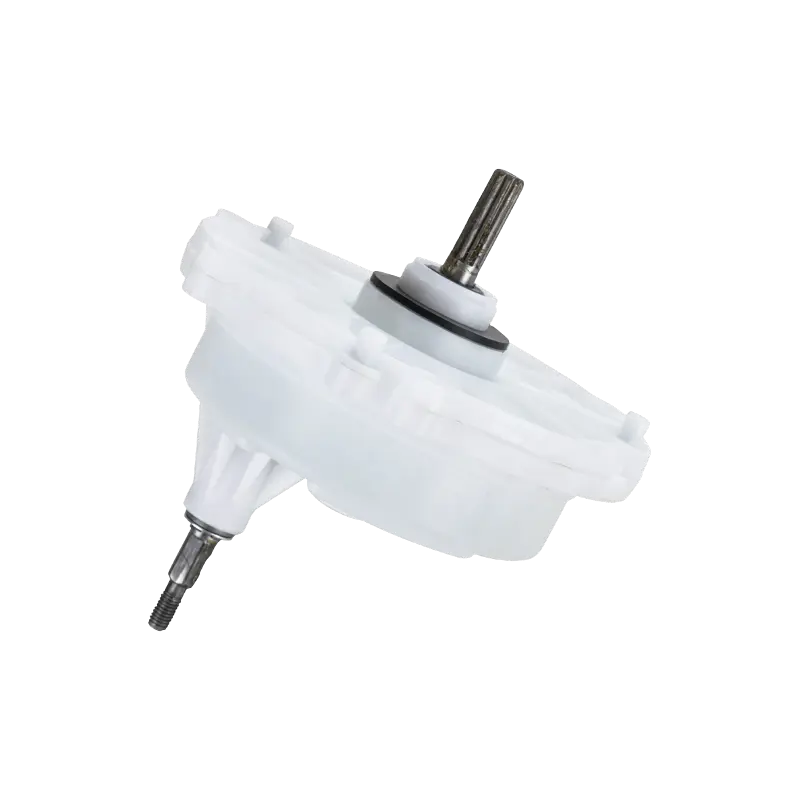
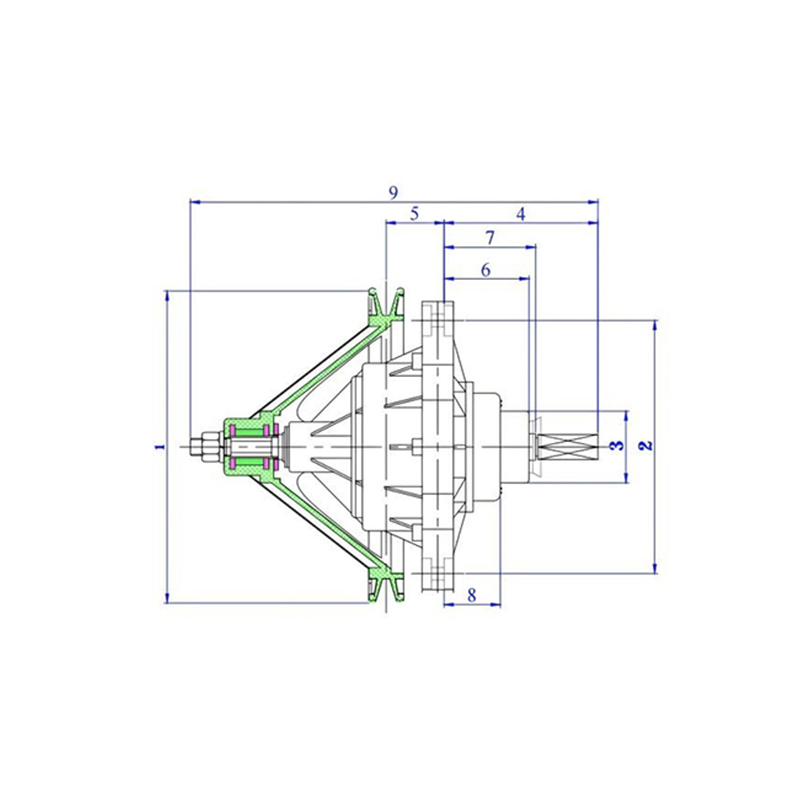 GT005 Washing Machine Transmission for Semi-Automatic Agitator WashersSealed, maintenance-free transmission with plastic gears and 1:5 ratio, suited to low-speed, high-torque agitator washing machine applications.View Product →
When specifying or cross-referencing a unit, always match the shaft spline count and diameter, the mounting bolt pattern, the overall height and the output direction before checking the ratio. Two gearboxes that look identical from the outside can differ in every one of those dimensions.
Most transmission failures are tribological, not structural: seals, lubricant and clutch linings give out before the gears break.
Transmission, Coupler, Belt, Clutch or Motor? Sorting the Symptom
Replacing a transmission is expensive, and many "bad transmission" diagnoses turn out to be a five-dollar coupler or a stretched belt. Sorting the symptom before ordering parts saves money on both sides of the counter.
Common top-load symptoms and the components most often responsible, listed roughly in order of cost and frequency.
| Symptom |
Check first |
Check second |
Transmission likely? |
| Motor hums, no agitation, no spin |
Motor coupler or drive belt |
Capacitor, motor windings |
Unlikely |
| Agitates but will not spin |
Lid switch, drain status |
Clutch lining, brake |
Possible |
| Grinding or whining during spin |
Tub bearing, foreign objects |
Gear tooth damage |
Possible |
| Oil or dark grease marks on laundry |
Output shaft seal |
Housing crack |
Yes |
| Loud knocking during agitation only |
Agitator dogs or drive block |
Worn gear or shaft spline |
Possible |
| Water will not drain |
Pump, hose, drain valve |
Timer or board |
No |
Two habits make diagnosis faster. First, always confirm the machine drains and the lid switch reads correctly before blaming the drivetrain, because a washer that will not drain will not spin either. Second, listen to the machine at the exact moment the fault appears. A knock that only occurs when the agitator reverses direction points at the agitator drive, while a rumble that builds through the spin ramp points at the clutch or the output bearing.
On twin-tub models the split is even clearer, because the wash motor and the spin motor are separate. If the pulsator turns but the spin basket stays still, the reducer is probably fine and the spin side is at fault. If the pulsator is sluggish under load but the motor sounds healthy, the reducer or the belt is the more likely culprit.
Rule out the cheap parts first: coupler, belt, lid switch and drain status explain a large share of faults blamed on the gearbox.
Failure Signs and a Safe Diagnosis Sequence
Transmissions fail slowly. The warning signs are consistent across platforms even when the internal design differs.
- Metal particles or grey sludge in the drained water, suggesting gear or bearing wear.
- A rumbling or whining noise that rises with spin speed and disappears at low rpm.
- Grease or oil staining on fabrics after a wash, indicating a failed output seal.
- Progressive loss of agitation force under a full load, long before total failure.
- A hard, sudden engagement at the start of spin, often accompanied by belt squeal.
The diagnostic sequence should be boring and repeatable. Disconnect power and water, drain the tub, remove the cabinet, and inspect the belt or coupler before anything else. Check that the agitator turns by hand with normal resistance and that the basket rotates freely with the lid switch bypassed only for inspection purposes on older mechanical models. Look for water tracking down the output shaft, which shows as a rust stain or a washed-out grease ring around the seal.
If the shaft turns freely with the motor running but the agitator does not move, suspect stripped splines or agitator dogs before the gear train. If the whole assembly locks, suspect a broken gear tooth or a seized bearing. Neither condition is repairable inside a sealed unit, and both call for replacement rather than a rebuild.
Safety matters more than speed here. Tub suspension springs are under load, the capacitor can hold a charge after power is removed, and the brake can release unexpectedly when the case is opened. Anyone servicing transmissions regularly should treat the tub as a stored-energy assembly, not just a container.
Noise that tracks spin speed plus oil staining on laundry is the clearest combined indicator of an internal transmission fault.
Direct-Drive and Front-Load Machines: When There Is No Transmission
"Direct drive" is one of the most misread labels in appliance marketing. On several top-load platforms, the motor is bolted directly to the transmission input with a coupler instead of a belt, and the gear case is still there, doing exactly the same job. The belt disappeared; the transmission did not.
On front-load machines the story is different. A drum only needs to rotate about one axis, so a belt and pulley or a direct-mounted brushless motor can handle the entire job. Speed control comes from the inverter board, direction changes come from switching the motor phases, and the pulley ratio supplies whatever speed reduction is needed. There is no gear train to wear, no clutch lining to slip and no shaft seal to leak into a grease chamber.
That does not make front-loaders more reliable overall. It relocates the weak points. Drum bearings run in a wet environment behind a seal, the drum spider corrodes in aggressive detergent conditions, and shock absorbers and springs take the vibration load. When a front-load machine rumbles in spin, the transmission is not on the list of suspects.
Impeller top-loaders, which use a low-profile disc instead of a tall agitator, follow the front-load logic much of the time. The board reverses the motor, and a small reducer appears only where the pulsator needs extra torque. Buyers sourcing components for that category should confirm the drivetrain type from the service manual rather than assuming from the product name.
"Direct drive" usually means no belt, not no gearbox. Always confirm from the parts diagram whether a gear case sits between the motor and the agitator.
The Shaft Side: P-Shaft, Pulsator Shaft and Drive Shaft
The transmission gets the attention, but the shafts carrying its output often decide how long a drivetrain survives. The P-shaft, also called the pulsator shaft, runs from the gearbox output up through the tub base to the pulsator or agitator. Its top end is splined or keyed, its lower end runs through a seal, and the middle section is exposed to detergent, lint and grit on every cycle.
Three details drive quality on this part. The spline profile must hold torque without rocking, because a loose fit hammers the teeth a little more each stroke. The bearing surface below the seal must be hard and smooth enough to survive years of rotation against a rubber lip. And the seal seat area must be dimensionally stable, since a shaft that runs slightly eccentric will destroy a new seal within months.
- Spline wear shows up as a machine that agitates weakly or stops when the load is heavy.
- Seal wear shows up as water in the tub base, rust around the shaft and eventually bearing noise.
- Bending or runout shows up as vibration that survives balancing and points back to the shaft.
For aftermarket buyers, shaft kits are a natural companion item to gearboxes. A repair that replaces the transmission but reuses a worn P-shaft tends to come back. Selling the two together, with the correct seal and mounting hardware, reduces returns and complaints.
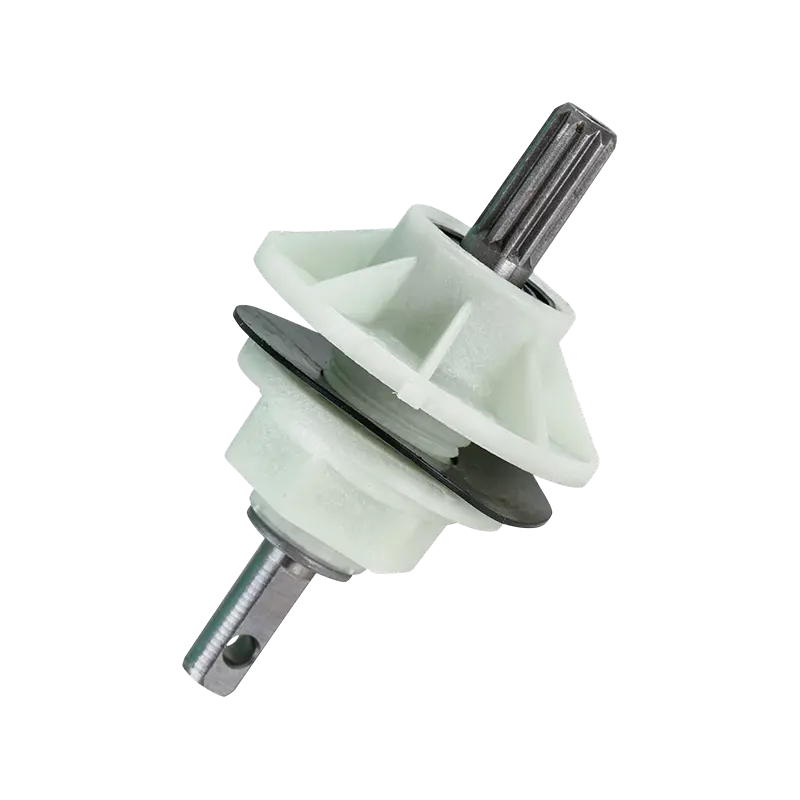
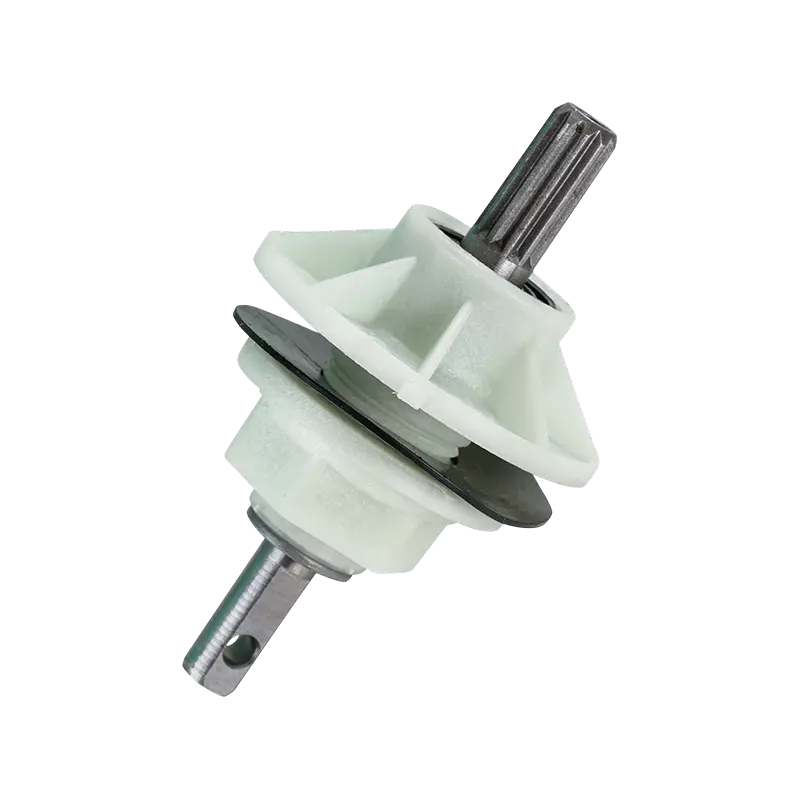 Washing Machine P-Shaft Assembly for Twin-Tub and Semi-Automatic WashersDirect-drive pulsator shaft that transmits motor power to the spin drum and supports stable high-load spin drying in twin-tub washer repairs.View Product →
When comparing suppliers, ask for the spline tolerance and the surface hardness of the seal journal rather than only the material grade. Those two values predict field life far better than a general statement about using quality steel.
A new gearbox fitted to a worn P-shaft is a repeat repair waiting to happen; treat shaft and reducer as one service unit.
Twin-Tub and Semi-Automatic Gearboxes: Different Rules
Twin-tub washers remain a major category in many export markets because they are simple, repairable and tolerant of unstable power. Their drivetrain is split: one motor drives the pulsator through a small reducer, and a second motor drives the spin basket, usually by belt.
The reducer on these machines works under conditions that would destroy a sealed top-load gearbox quickly. Detergent is often dosed by hand, water can be hard, and a single wash may run far longer than a Western automatic cycle. Gears are commonly a mix of steel and engineering plastic, and the housing may be aluminium or moulded. That combination is entirely appropriate for the price point, as long as the gear pair is designed for the duty.
Common failure modes follow directly from that environment. Plastic gear teeth strip when a user overloads the tub or starts the machine with fabric wrapped around the pulsator. Water ingress through the top seal turns the grease milky and accelerates wear on the shaft. And because the reducer is often buried under the tub, failures are noticed late, after noise has been present for weeks.
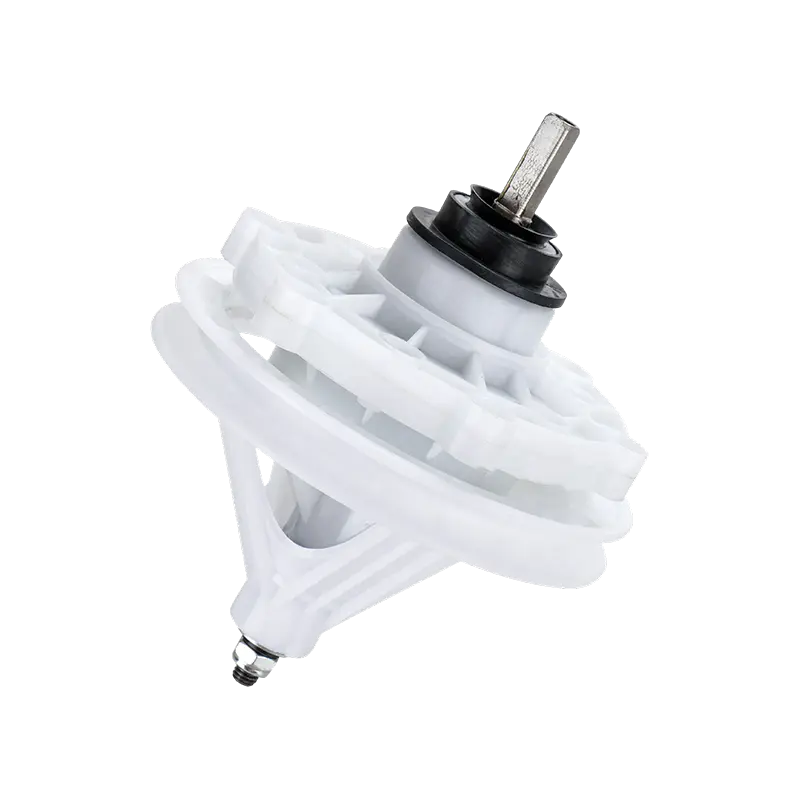
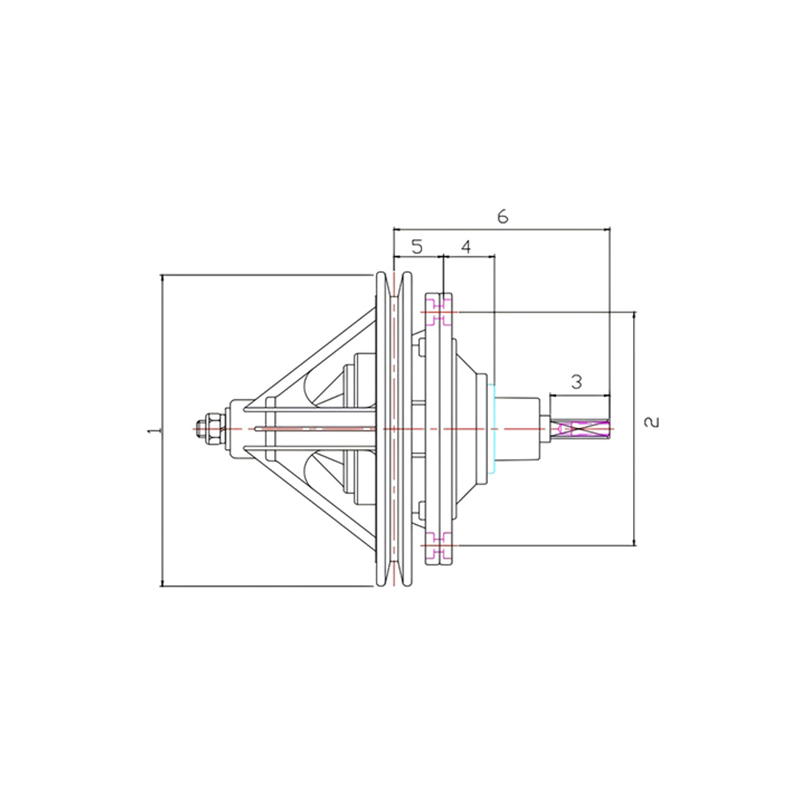 GT003 Semi-Automatic Washing Machine Gear Box for Agitator WashersPlanetary gear box with lightweight plastic gearing and 1:3.67–1:5 ratios, intended for low-speed, high-torque agitator washer transmission.View Product →
For distributors serving these markets, the sensible inventory strategy is a small number of high-runner reducers plus matching seals and pulsators, rather than a broad catalogue of low-turnover variants. Repair shops in these regions usually want a complete drop-in unit, not individual gears.
Twin-tub reducers live in harsher conditions than automatic gearboxes, so seal quality matters as much as gear strength.
What OEM and Aftermarket Buyers Should Specify Before Ordering
Most sourcing problems start with an incomplete specification. Two gearboxes can share a part number family and still differ in ratio, shaft geometry, housing height or clutch behaviour. The checklist below covers the values that should appear on any enquiry sent to a manufacturer or supplier.
Core specification fields for a washing machine transmission enquiry, grouped by function.
| Field |
Why it matters |
Typical form of the value |
| Reduction ratio |
Sets agitator speed and available output torque |
Ratio at agitate stage, ratio at spin stage |
| Rated and peak torque |
Determines whether the unit survives unbalanced spin |
Nominal value plus short-duration peak |
| Shaft geometry |
Controls fit to agitator, pulsator and spin tube |
Spline count, diameter, length, keyway |
| Mounting interface |
Must match the tub base and frame without adapters |
Bolt pattern, hole pitch, pilot diameter |
| Housing material and finish |
Affects stiffness, corrosion resistance and noise |
Die-cast aluminium, coating specification |
| Sealing and lubricant |
Defines resistance to water ingress and wash chemicals |
Seal type, grease grade, lifetime fill |
| Noise target |
Increasingly a consumer-facing acceptance criterion |
Sound level at defined speed and distance |
| Compliance |
Required for most export programmes |
ISO 9001, ISO 14001, RoHS declarations |
Two fields deserve extra attention. Noise is often written loosely as "low noise" when it should be a measurable target at a defined operating point, otherwise there is nothing to reject against. Life testing should also be defined in cycles of realistic load rather than hours of bench running, because a gearbox that idles smoothly for a week may still fail in the first month of unbalanced spins.
Aftermarket buyers have an additional requirement that OEM programmes often ignore: packaging and identification. A unit that arrives without a clear label, seal kit or fitting note generates returns from repair shops that cannot confirm what they received. Carton printing, barcodes and language variants are worth specifying at the quotation stage rather than discovering at the first shipment.
An enquiry without ratio, peak torque, shaft spline and mounting pattern is not a specification; it is a request for a guess.
Choosing a Manufacturer or Wholesaler: Cost, Risk and Delivery
Price per unit is the easiest number to compare and the least useful on its own. A transmission that costs a little more but holds its seal for the full service life is cheaper across a container than one that returns as a warranty claim. The evaluation below is a practical way to compare candidates without a formal audit.
- Vertical integration. Suppliers who cut, heat-treat and assemble gears in house control tooth quality far better than traders who buy finished units and relabel them.
- Process documentation. Ask for control plans, inspection records and material certificates. A manufacturer with a working quality system produces these without drama.
- Sample evaluation. Bench test samples at the load profile from your own market rather than the supplier's standard cycle.
- Repeatability. Order the same part number three times and compare. Variation between lots is the clearest sign of an unstable process.
- After-sales clarity. Confirm who handles claims, how spare seals are supplied and what the response time is on a defective batch.
Lead time deserves its own conversation. A wholesaler quoting four weeks on a part that actually takes ten will damage a distribution business more than a slightly higher price. Ask for the production lead time, the minimum order quantity, and the realistic shipping window separately, then check that the three fit together.
For B2B buyers entering this category for the first time, a useful shortcut is to start from an established technical guide rather than a catalogue. The washing machine gearbox manufacturer guide on this site walks through the main transmission types and comparison points, which makes the specification conversation with any supplier faster and more concrete.
Compare suppliers on process control and lot-to-lot repeatability, then on price; the reverse order produces warranty costs that erase the saving.
FAQ: Washing Machine Transmissions
Does a washing machine have a transmission?
Most top-load agitator washers and twin-tub semi-automatic washers do. The transmission, also called a gearbox or reducer, converts continuous motor rotation into the oscillating wash action and then locks up for the spin stage. Front-load washers and most impeller top-loaders generally do not have one.
Do front-load washers have transmissions?
Rarely. A front-load drum only rotates in one plane, so an inverter-controlled motor with a belt and pulley or a direct drum mount handles everything. Speed reduction comes from pulley ratio, and direction changes come from the control board rather than a gear train.
What does a bad washer transmission sound like?
Usually a rumble or whine that rises with spin speed and fades at low speed, sometimes with a knock at the moment agitation reverses. A single loud bang at spin start more often points to a clutch or brake issue than to gear damage.
My washer agitates but will not spin. Is the transmission gone?
Not necessarily. Check the lid switch, confirm the tub drains fully, and inspect the clutch and brake before condemning the gearbox. On many platforms the spin fault sits outside the transmission entirely.
How long should a washer transmission last?
Field life varies widely with load habits and water quality, but a well-sealed unit in a domestic setting commonly outlasts the machine's other major components. Overloading and frequent unbalanced spins shorten that considerably.
Can a transmission be repaired rather than replaced?
In the field, almost never. The housings are sealed, lubricant is filled for life, and internal parts are not sold as service items for most models. Replacement at assembly level is the practical route for repair shops.
What should a wholesaler look for in a transmission supplier?
In-house gear production, documented quality control, consistent sample performance across lots, clear compliance declarations, and a realistic lead time. A supplier that can explain why a design suits a given load profile is usually more reliable than one that only quotes a price.
The common thread across every question is architecture: identify the drivetrain type first, and most transmission questions answer themselves.
Transmissions are one of the few remaining mechanical assemblies in a modern washer, and they survive or fail on details that are easy to overlook: a seal lip, a spline tolerance, a clutch lining, a lubricant that stays stable through thousands of hot wash cycles.
If you are sourcing gearboxes, reducers, P-shafts, synchronizers or clutch assemblies for OEM programmes or aftermarket distribution, it helps to work with a manufacturer who builds the drivetrain rather than resells it. Our production is concentrated on washing machine transmission components, with ISO 9001 and ISO 14001 certification and RoHS-compliant materials, and with a factory in Cixi that has been supplying appliance makers since 2002.
Useful pages for technical and purchasing teams
Bring a sample, a shaft drawing or an existing part number, and the specification conversation starts from something concrete rather than a catalogue page.
Match the drivetrain architecture, the load profile and the sealing standard, and the gearbox decision becomes a measurable engineering choice rather than a price negotiation.

 English
 عربى


 +86-574-63256717 /63267914
info@gaite.cn
 gaite@gaite.cn
 No. 208 Miaoshan Road, Shiyan Village, Henghe Town, Cixi City, Ningbo City, Zhejiang Province, China
